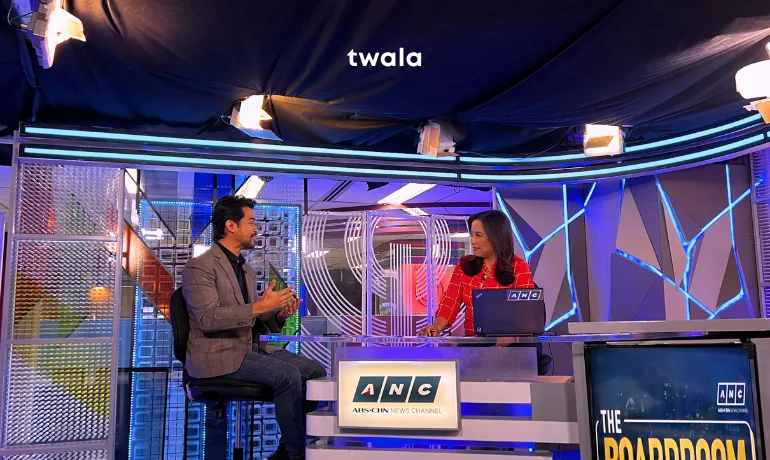
Twala, One of the Philippines' First Supreme Court-Accredited Electronic Notarization Facilities (ENFs), Invited by CREBA to Talk eNotarization for Real Estate
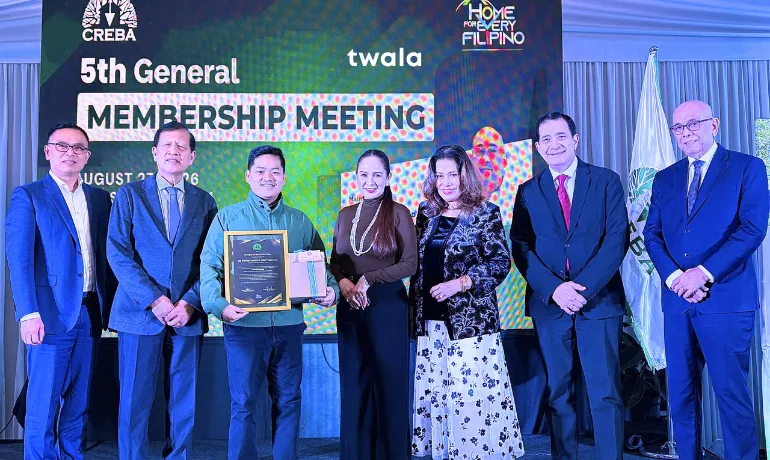
MAKATI CITY, Philippines — August 27, 2026 — Twala joined real estate industry leaders at the Chamber of Real Estate and Builders' Associations, Inc. (CREBA) 5th General Membership Meeting today, with Mr. Jiggy Calucag, Twala's Director for Government Relations, appearing as Resource Person before CREBA's National Board and member-chapters at the Glass Pavillion, Dusit Thani Hotel, to walk the industry through what electronic notarization means for the way property transactions get closed in the Philippines.
The session came at a meeting themed around CREBA's mission, "A Home for Every Filipino," presided over by National President Mr. Noel Toti M. Cariño, and featured Atty. Gerardo P. Sirios, Administrator of the Land Registration Authority (LRA), as Guest of Honor and Speaker.
Why real estate still runs on paper
Calucag opened his segment by naming the problem plainly: despite nearly everything else in business going digital, the way documents are executed, signed, and notarized has barely changed — and the Philippines still runs primarily on paper. He grounded this in a scenario every CREBA member recognized instantly: a Deed of Sale or Deed of Assignment that has to be printed, physically signed, notarized in person, couriered or hand-carried between parties, and filed with the Registry of Deeds — a process that can stretch a straightforward transaction across days or weeks.
He noted that this isn't a niche inconvenience. More than 40 document types commonly require notarization in the Philippines, and every one of them carries the same drag: processing delays, printing and courier costs, notarial fees, travel time, and lost productivity on both sides of the transaction.
eNotarization as the missing piece
Calucag positioned eNotarization as the piece that finally completes the digital document workflow — closing the gap between simply e-signing a document and having a fully executed, notarized instrument that holds up in court.
He walked the room through the legal foundation behind this shift, which is not as new as many assume. The groundwork was laid over two decades ago with the Electronic Commerce Act (R.A. 8792) in 2000 and the Rules on Electronic Evidence in 2001. What's new is the Supreme Court's Rules on Electronic Notarization, approved earlier in 2025 and in effect since March 2025 — the product of a rule-development process Twala has been part of since its engagement with the Supreme Court began in July 2020. The first batch of accredited Electronic Notarization Facilities (ENFs), including Twala, was approved this August 5. The Court has since announced a summary hearing for that first batch on August 27–28 — a separate Supreme Court proceeding, distinct from today's CREBA meeting, though the dates happen to overlap — ahead of eNotarization being formally operationalized on October 19.
Two details drew particular interest from the CREBA floor: first, that a simple eSignature is still legally valid — the difference from a secure or digital signature isn't validity, it's the burden of proof required if it's ever challenged — though only secure electronic signatures and digital signatures qualify for notarization itself under the rules. Second, and arguably more consequential for a national association like CREBA: notarial jurisdiction is no longer confined to the city or municipality where a notary is commissioned. Under the new rules, an Electronic Notary Public can notarize regardless of where the parties are located in the Philippines — and even for Filipinos abroad, through an embassy or consulate. For an industry with buyers, sellers, and OFW clients scattered across provinces and continents, that alone reframes what's operationally possible.
Who Twala is
Calucag closed by introducing Twala to the room: a Philippine legal technology company offering secure digital signatures, electronic notarization, identity verification, and AI-powered document solutions, built on blockchain and public key infrastructure (PKI) so that individuals, businesses, and government institutions can execute and manage legally binding digital transactions securely and efficiently. He framed Twala's value in three parts — efficiency (faster execution and turnaround), cost savings (less printing, courier, and administrative overhead), and security and court admissibility (documents that are tamper-evident and hold up in court).
He backed that up with Twala's track record: officially accredited by the Supreme Court of the Philippines as an Electronic Notarization Facility; the only Philippine member of the Cloud Signature Consortium; backed by DOST-PCIEERD's Startup Grant Fund Program with R&D partnerships through DOST-ASTI; named Tech Innovator of the Year at the 2025 KMC Startup Awards, included in Esquire Philippines' 2024 Trailblazers List, and recognized as an ARTA Ease of Doing Business Champion for 2024 — and now serving more than 600 enterprise and institutional clients and 1.3 million individual users nationwide.
Why it matters for CREBA
CREBA's membership represents a significant share of the developers, brokers, and builders who move property transactions forward on notarized paperwork every day. The session closed with an open floor, giving members the chance to put their own adoption questions directly to Calucag and Atty. Sirios — a signal that the real estate industry isn't just watching this shift from the sidelines, but actively working out how to bring it into their own transactions.
"Kapag pinag-uusapan natin ang 'A Home for Every Filipino,' hindi lang ito tungkol sa pagtatayo ng bahay — kasama rin dito ang paggawa ng proseso ng pagbili at pagbenta nito na mas simple, mas ligtas, at mas mabilis para sa bawat Pilipino," sabi ni Calucag. "Iyan ang dala ng eNotarization sa CREBA at sa buong real estate industry."
("When we talk about 'A Home for Every Filipino,' it's not just about building homes — it's also about making the process of buying and selling them simpler, safer, and faster for every Filipino. That's what eNotarization brings to CREBA and the whole real estate industry.")
Twala thanks CREBA National President Mr. Noel Toti M. Cariño and the CREBA National Board for the invitation — and Platinum Partners Boysen, Vista Land, Community Development Corporation, and Cebu Landmasters, along with Event Partners Torre Lorenzo and Panasonic, for supporting the meeting — and looks forward to continued engagement with the real estate industry as digital notarization becomes standard practice in Philippine property transactions.