











For teams
Run every agreement in one workspace
Draft, sign, and store contracts with AI that answers from your own files, then follow every envelope to completion.
Explore featuresTwala turns documents into end-to-end workflows: AI contract generation and review, eSignature, eNotary, and secure storage, in one platform built for the modern enterprise.
On Twala’s Envelopes page, an envelope goes from Pending to In progress as its first signer signs, then an approver approves and a second signer signs. Twala seals it, it shows Completed, and HashOrigin anchors it on Polygon.















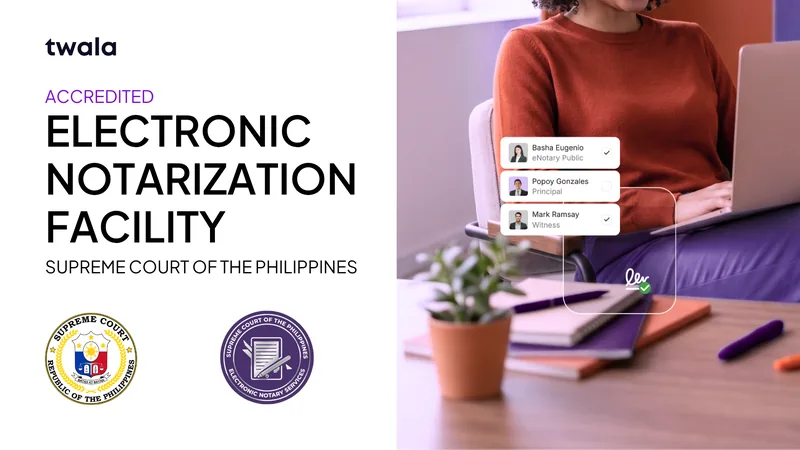
 Supreme Court of the PhilippinesAccredited ENF
 Integrated Bar of the PhilippinesOfficial Partner
 Department of Science & TechnologyGrant Recipient
 Cloud Signature ConsortiumOfficial Member
A walkthrough of the platform, from the first draft to a sealed record.
Businesses, legal teams, and notaries run their documents on Twala, from the first draft to a record anyone can verify.
Draft, sign, and store contracts with AI that answers from your own files, then follow every envelope to completion.
Explore featuresConduct electronic notarization on a facility accredited by the Supreme Court of the Philippines, with identity checks, session recording, and the notarial register built in, or take consultations as a lawyer, no commission needed.
Explore eNotarySigning at the notary’s session, lawyers and free legal aid, eGovPH sign-in, and new ways to connect Twala to the tools you already use.
Twala’s AI works across the whole lifecycle, so nothing stays buried in the fine print. Every step below is a live view of the product.
Upload a document and ask Lex anything: a summary, a clause, a key term. Answers name the files they came from, and Lex can search Philippine laws and jurisprudence when your files leave a gap.
Learn moreHashOrigin™ seals every completed document with a digital signature, records its SHA-256 fingerprint, and anchors it on the Polygon blockchain. Any change is detectable, and anyone holding a copy can verify it, with or without Twala.
TechnologyCustomer story“Twala has significantly helped our organization by securely automating our digital signature process. In our on-the-go work environment, Twala lets us approve documents anywhere, at any time, while keeping them in a secure cloud space.”
 Maximo Bernales Jr.CIO / Head of Business IT, Power Mac Center














Twala is architected around Philippine law and international eSignature principles. Every sealed document carries a digital signature over the whole file, and no user data is ever used to train the AI.
You pay for the people who send documents, not for the people who sign them. Prices are VAT inclusive.
Answers to what teams ask most. More in the user manual.
Twala is an accredited Electronic Notarization Facility (ENF) of the Supreme Court of the Philippines and a legal technology company that helps businesses, legal professionals, government agencies, and institutions execute, notarize, verify, and manage documents digitally and securely. Twala provides electronic signature, electronic notarization, digital identity, and AI-powered intelligent document solutions built on blockchain and Public Key Infrastructure (PKI). It is designed for organizations that need legally compliant, efficient, and secure document workflows: the digital execution, electronic notarization, verification, and lifecycle management of contracts, agreements, and other legally binding documents, without the friction of paper.
Yes. Twala complies with the Philippines' Electronic Commerce Act (RA 8792) and the Rules on Electronic Evidence (A.M. No. 01-7-01-SC), which recognize electronic signatures and documents as legally valid and enforceable. Twala is a Supreme Court-accredited Electronic Notarization Facility (ENF), built around the Rules on Electronic Notarization under A.M. No. 24-10-14-SC. Twala's framework also aligns with globally recognized eSignature principles, making Twala-executed documents valid in many major jurisdictions.
No. It is always free for your signers to sign documents. Signers can create a Twala account for free and send or store 5 documents a month.
A seat is someone who sends documents and requests eSignatures. We bill for the number of seats, not the number of signers.
Twala uses several layers of signatory verification: the signer's email address and mobile number, and AI-enabled ID verification that requires a government-issued ID and a live selfie to confirm the signer's identity before they can sign.
Yes. Twala is built with enterprise-grade security at every layer. All documents and data are encrypted at rest and in transit, and hosted on cloud infrastructure with disaster recovery safeguards. Every signed document is anchored using blockchain and PKI technology for tamper-evidence and authenticity. Twala also uses AI-powered biometric verification to confirm signer identity, single sign-on (SSO) for secure account access, and continuous security monitoring to detect and respond to threats in real time. Twala adheres to international standards on information security and data privacy.
Yes. Choose Continue with eGovPH on Twala’s sign-in page. Every eGovPH account is already identity-verified by eGovPH, so signing in with it also verifies your identity on Twala: no face scan, no ID photo, and no identity verification fee.
Yes. Any AI tool that supports custom connectors through the Model Context Protocol (MCP) can connect to your Twala account, on every plan at no extra charge. It acts as you, sees only what you can see, never reads what your documents say, and never signs for anyone. Disconnect it anytime from AI connectors in your account menu.
Yes. Twala now supports API integrations: create an app on the Apps page, issue test and live API keys, and send envelopes, timestamp documents, receive webhooks, and embed signing in your own website or app. The developer guide has the full reference. Resellers and system integrators can talk to us about partnering.
Yes. Members of the Philippine Bar in good standing can apply as a lawyer to take consultations on Twala, be listed on the Partner Network, and be recommended to clients. A notarial commission is needed only to notarize.
Yes. Under the Supreme Court’s Unified Legal Aid Service (ULAS), you can ask a lawyer or notary with the ULAS badge for a free consultation or notarization, with proof of indigency. They approve it as legal aid, offer a fee instead, or decline.