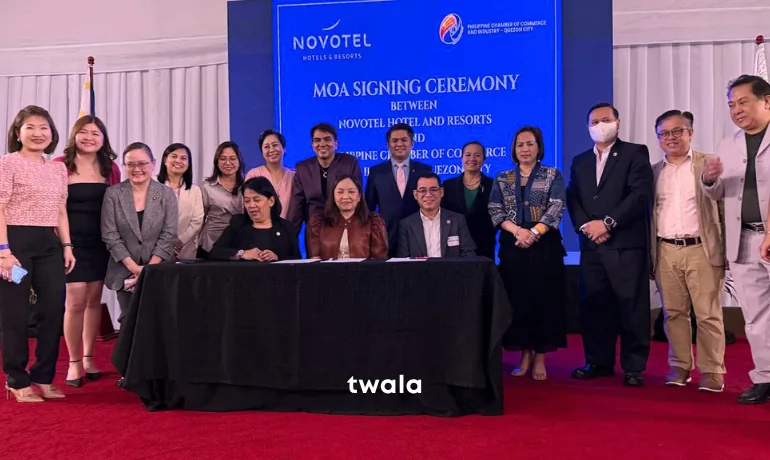
eSignature, Digital Signature, or eNotarization: Which Does Your Document Need?

Most documents in the Philippines need only an eSignature, some are worth a digital signature’s stronger proof, and a smaller set must be notarized, which can now happen online through eNotarization.
The three get confused because they overlap. Every digital signature is a kind of electronic signature, and every eNotarized document carries secure electronic or digital signatures. But each one answers a different question. An eSignature shows that someone agreed. A digital signature proves who signed and that nothing changed afterward. Notarization puts a commissioned lawyer between the signer and everyone else, and turns a private document into a public one.
Which one you need depends less on technology than on the document, and on who will receive it.
The quick answer
| Document | What it usually needs | Why |
|---|---|---|
| Internal approvals, purchase orders | eSignature | No particular form is required; you need a record of who approved what, and when |
| NDAs, service agreements, employment contracts | eSignature, with digital-signature proof | Valid without notarization; strong proof matters if the contract is ever challenged |
| Affidavits | Notarization (a jurat) | A sworn statement is made under oath before a notary or another officer authorized to administer oaths |
| Special powers of attorney | Notarization (an acknowledgment) | Banks, registries, and government offices commonly ask for a notarized SPA |
| Deeds of sale for land, real estate mortgages | Notarization | The law requires a public document for many transactions involving real property |
| Notarial wills, depositions | Paper notarization | Not covered by electronic notarization; they stay under the 2004 Rules on Notarial Practice |
“Usually” is doing real work in that table. A bank, a registry, a school, or an embassy can ask for more than the law does, so check the receiving party’s requirements before anyone signs.
eSignature: proof that someone agreed
An electronic signature is any electronic mark or process that shows a person meant to sign: a typed name, a drawn signature, a click on “I agree.” The Electronic Commerce Act (R.A. 8792) and the Supreme Court’s Rules on Electronic Evidence (A.M. No. 01-7-01-SC) recognize electronic signatures and electronic documents as legally valid. And under the Civil Code, a contract is valid whatever its form, as long as consent, object, and cause are present, unless the law requires a particular form.
A simple eSignature is valid. Its weakness shows only when someone challenges it, because then the party relying on it has more to prove: that the signature is genuine and that the document hasn’t changed since. For internal approvals and everyday agreements, that is often an acceptable risk.
Digital signature: proof of who signed and what they signed
A digital signature is an electronic signature built on public key infrastructure (PKI). It ties the signature to a certificate and to the exact contents of the file, so anyone checking it can confirm the signer and see whether anything changed after signing. That is why it suits sensitive contracts and regulated work: the proof travels with the document.
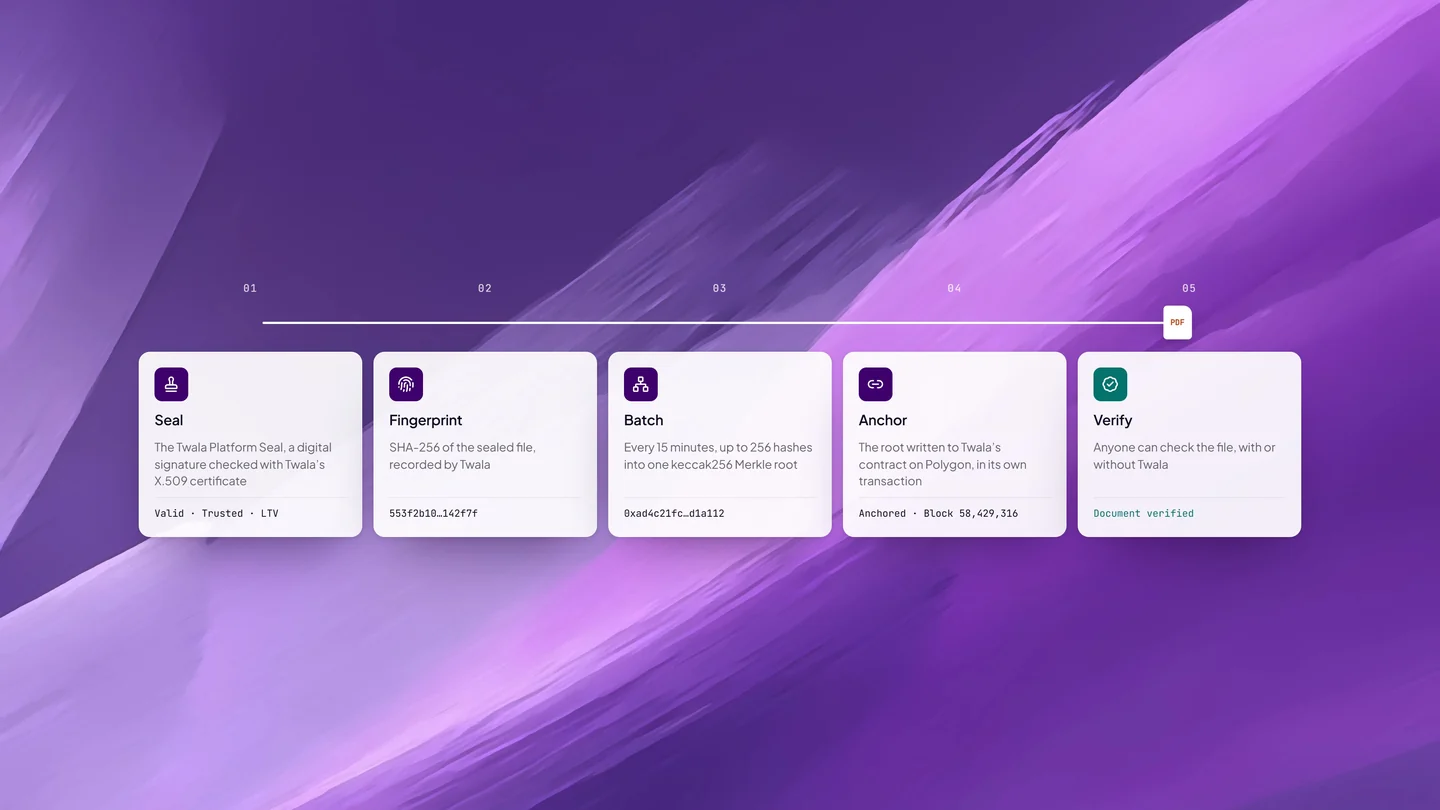
On Twala, you don’t have to choose between the first two. Every document signed on Twala is sealed with the Twala Platform Seal, a digital signature made with Twala’s X.509 certificate, with a trusted timestamp inside it. The file is converted to PDF/A-2b, the archival standard, before it is sealed, and its fingerprint is anchored on the Polygon blockchain with HashOrigin™ technology. A sender can also require signers to verify their identity with a government-issued ID and a live selfie before they sign. So even a routine approval carries the kind of proof a digital signature gives. Read how HashOrigin works for the details.
For the mechanics of the first two, our explainer on digital and electronic signatures goes deeper, and the legalities of eSignatures in the Philippines covers the law.
eNotarization: when the law or the receiver wants a public document
Notarization is not a stronger signature. It is a different legal act. A commissioned notary confirms the signer’s identity, makes sure the signer understands the document and signs freely, and certifies it. The result is a public document: admissible in evidence without further proof of its authenticity, with a presumption of regularity that only clear and convincing evidence can overturn. As Atty. Third Bagro, Twala’s co-founder and general counsel, puts it, “Notarization is not an obsolete formality.”
So the deciding question is not how secure you want the signature to be. It is whether anyone requires a public document. Some contracts must be in one by law, most notably those involving rights over real property. Agencies and institutions ask for notarized statements all the time: to replace a lost ID, take out a loan or a mortgage, document certain corporate acts, or claim insurance and other benefits.
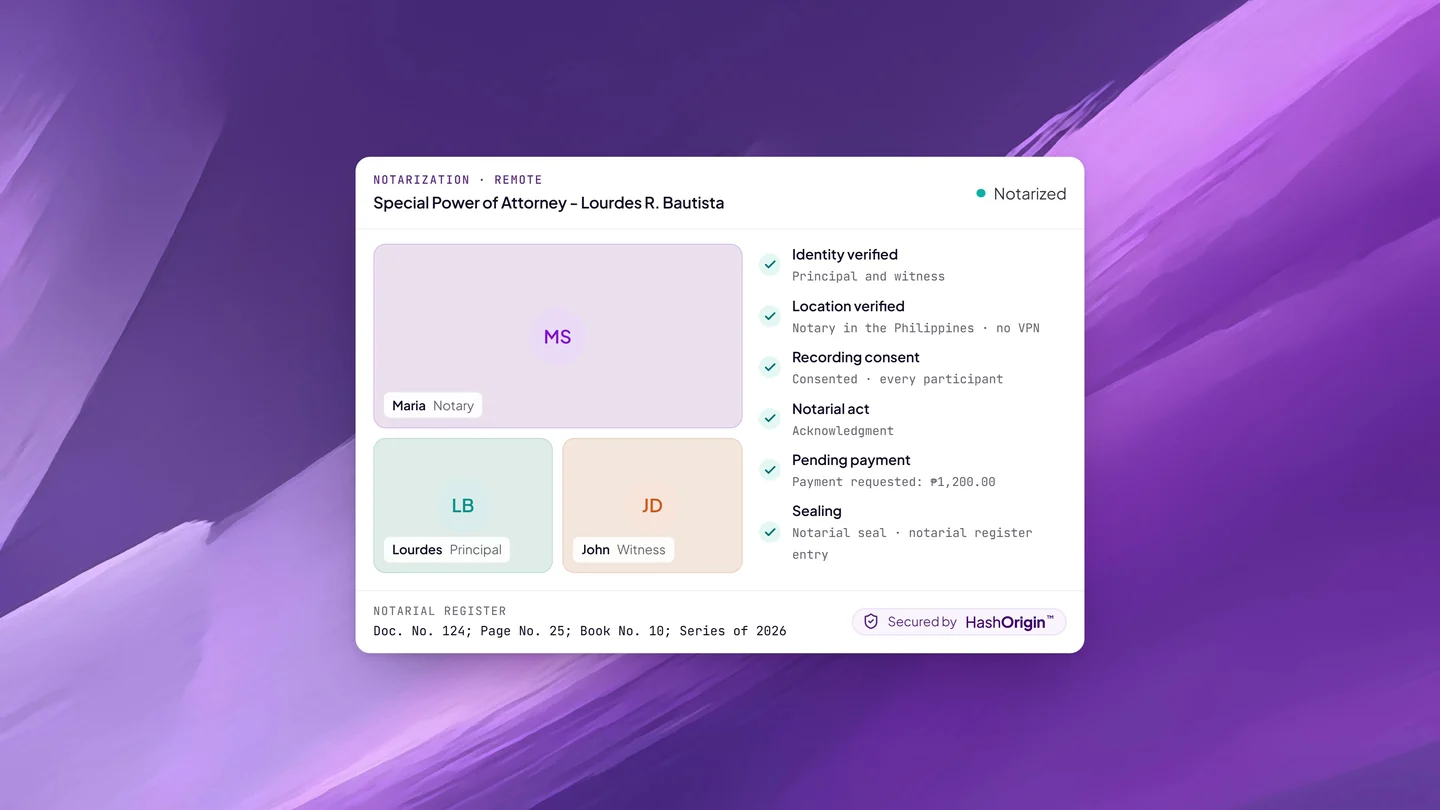
Since the Supreme Court’s Rules on Electronic Notarization (A.M. No. 24-10-14-SC), that public document can be electronic. An Electronic Notary Public (ENP) notarizes the PDF through an accredited Electronic Notarization Facility (ENF) such as Twala, either in person or over live video, and under the Rules, appearing by videoconference counts as appearing in person. The act has the same validity, force, and effect as a traditional one.
The Rules also settle who signs when. Only secure electronic signatures and digital signatures qualify for notarization, so a pasted image of a signature won’t do. For an acknowledgment, such as a deed or an SPA, you can sign on Twala before the session and confirm to the ENP that the signature is yours. For an affidavit (a jurat) or signature witnessing, the Rules have you sign as part of the act, so ask your ENP on the Messages tab when to sign; you can book first and send the document for signing when your ENP says.
Three questions to decide
- Does the law, or whoever receives the document, require notarization? If yes, eNotarize it, provided the document type is covered and everyone appearing is in the Philippines. If you aren’t sure, ask the receiving office before anyone signs.
- If not, could the document be disputed, audited, or relied on years from now? Then you want a digital signature’s proof. On Twala, every signature comes with it.
- Is it routine? An eSignature is enough. Keep it in the same workspace as everything else, so you can find it when someone asks.
One flow on Twala
On Twala the three are steps in one flow rather than separate products. A contract drafted in the editor goes out in an envelope for eSignature, comes back sealed, and, if it needs notarization, goes to an ENP through an appointment without leaving the platform. From draft to notarized follows one document through every step, and how to notarize a document online covers the notarization screen by screen.
Frequently asked questions
Is a contract signed with an eSignature valid without notarization?
Generally, yes. A contract is valid when consent, object, and cause are present, and the law recognizes electronic signatures. Notarization is needed when the law requires a public document, or when the party receiving the contract asks for one.
Does a digital signature replace notarization?
No. A digital signature proves who signed and that the file hasn’t changed. Notarization is a separate act by a commissioned notary, who verifies identity and voluntariness and makes the document a public one.
Can I eNotarize a PDF that was signed in another app?
Twala notarizes documents signed with Twala’s secure digital signature. Upload the PDF and have it signed on Twala: before the session for an acknowledgment, or when your ENP says for an affidavit or signature witnessing.
What does each one cost on Twala?
Signing is free for signers, and the free Personal plan lets you send and store 5 documents a month. A notarization costs the notarial fee your ENP sets, plus 12% VAT and documentary stamp tax when paid online. The details are in how much online notarization costs.
New to all of this? Our complete guide to eNotarization in the Philippines starts from the beginning, or you can create a free Twala account and send your first document for signature.
Twala is a Supreme Court-accredited Electronic Notarization Facility (ENF). Twala is a technology provider and does not give legal advice. Notarial acts are performed by commissioned Electronic Notaries Public.