eNotarization Is Live in the Philippines: What Changed on October 19

Electronic notarization went live in the Philippines on October 19, 2026, and the country’s first two eNotarized documents were notarized on Twala. Here is what the launch changes for you.
The launch, held in Taguig City, centered on two agreements. One, with the Integrated Bar of the Philippines (IBP), supports free legal aid. The other, with the University of the Philippines College of Law, covers legal technology and artificial intelligence. Both were electronically signed and notarized on Twala in a ceremony witnessed by First Lady Louise Araneta-Marcos, a lawyer, and Senior Associate Justice Marvic M.V.F. Leonen, along with DICT Secretary Robert Joseph de Claro, ARTA Director General Secretary Ernesto V. Perez, and representatives of government, the legal profession, business, banking, and real estate. Senator Francis “Kiko” Pangilinan sent a recorded message.
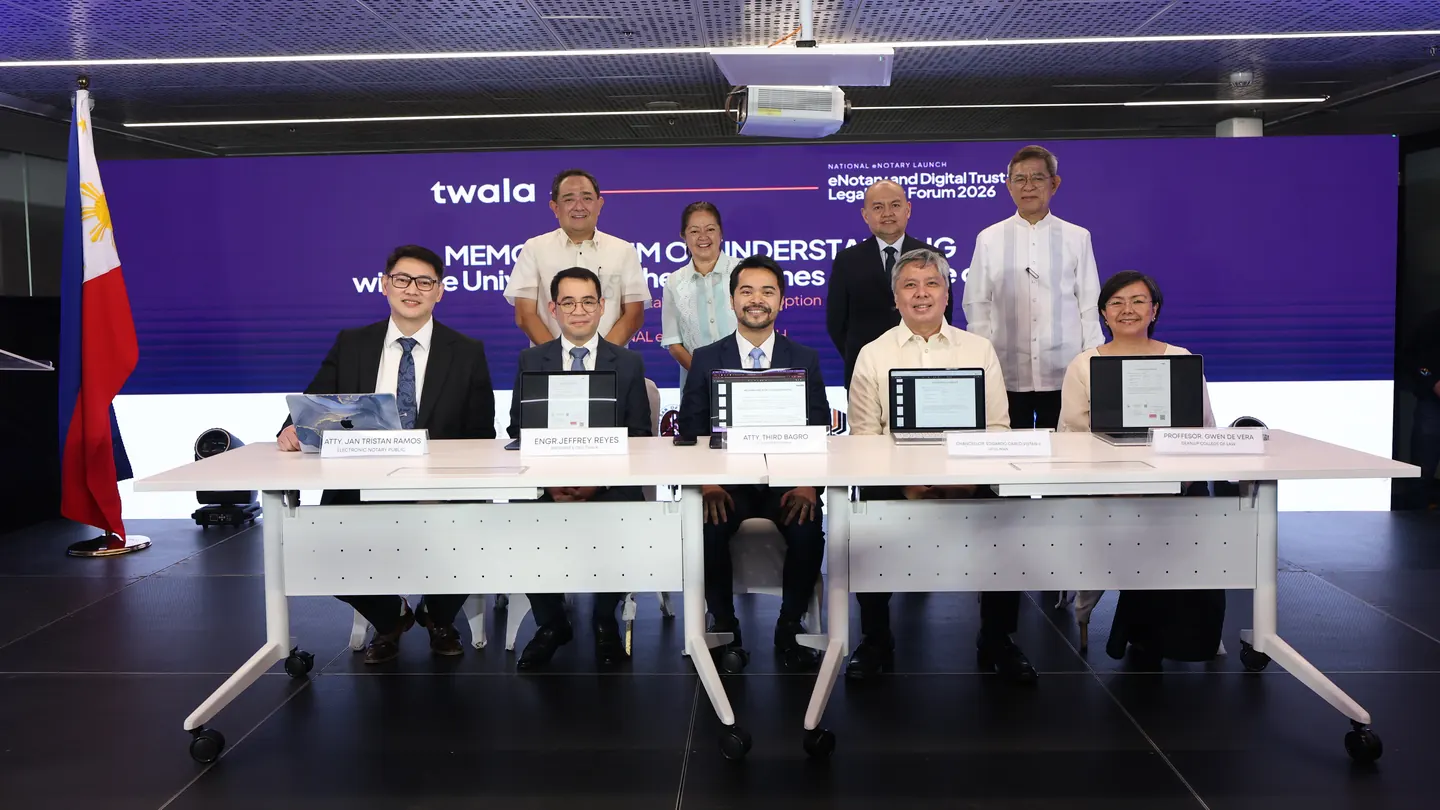
Our report from the launch covers the event itself. This post is about what it means the next time you need something notarized.
You no longer have to travel to a notary
Before the launch, notarizing usually meant appearing in person before a notary commissioned for the place where you were, printed document in hand. Now you can appear before an Electronic Notary Public (ENP) by live video from home, the office, or the province, and under the Rules on Electronic Notarization that videoconference is the equivalent of appearing in person. Everyone in the session has to be in the Philippines. An ENP can notarize for parties anywhere in the country, so the lawyer does not have to be in your city.
On Twala, you verify your identity once (it stays valid for up to three years), request an appointment with the ENP you choose, have the document signed on Twala, join the session, and pay online. For an acknowledgment, such as a contract or a power of attorney, you can sign on Twala before the session and confirm your signature to the ENP. For an affidavit (a jurat) or signature witnessing, the Rules have you sign as part of the act, so ask your ENP on the Messages tab when to sign. Our step-by-step guide shows each screen.
The offices you deal with now have rules for eNotarized documents
A notarized document is only useful if the office receiving it accepts it. On October 13, 2026, six days before the launch, the Supreme Court signed two joint memorandum circulars at its En Banc Session Hall: SC-LRA JMC No. 1, s. 2026, the “Guidelines for the Use of Electronically Notarized Documents in Transactions with the Land Registration Authority and Registers of Deeds,” and SC-SEC JMC No. 1, s. 2026, on the “Acceptance and Integration of Electronically Notarized Documents in SEC Systems and Transactions.” Associate Justice Alfredo Benjamin Caguioa said the circulars “categorically clarify the acceptability of eNotarized documents.”
In practice, the Land Registration Authority, the Registers of Deeds, and the Securities and Exchange Commission now have guidelines for eNotarized documents. Each office still has its own specific requirements, so check them before you book. The Supreme Court’s announcement has the details of the signing.
A notarized document can now prove itself
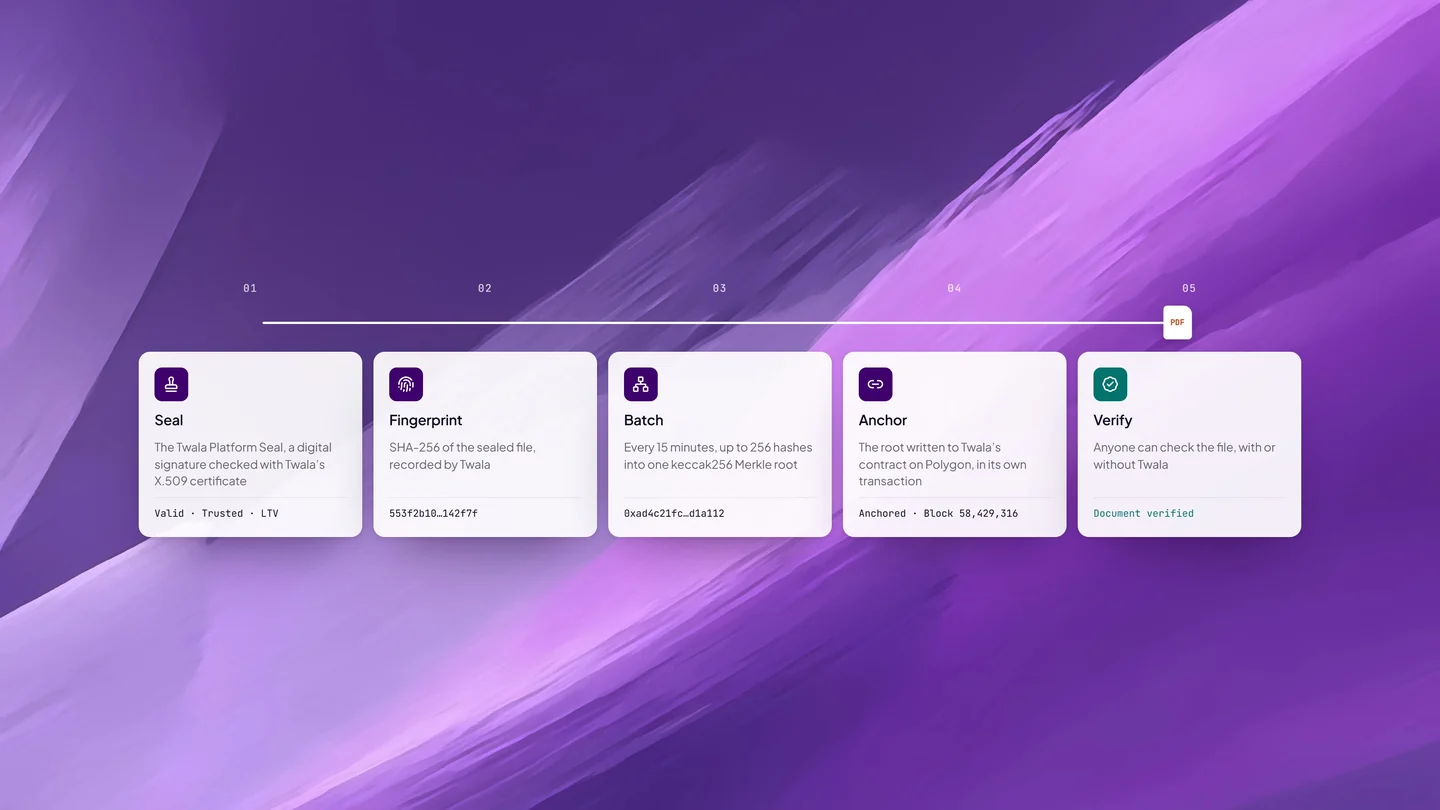
A paper notarization is a stamp, a signature, and an entry in a book you never see. An eNotarized document on Twala is a PDF with a notarial certificate page, the notary’s seal, and a QR code, sealed with a digital signature and anchored on a blockchain through Twala’s HashOrigin™ technology. Each notarized document is uploaded to the Supreme Court’s Central Notarial Database, and the act is entered in the notary’s electronic register.
For anyone who receives the document, that means checking it instead of trusting it. On Twala’s verify page, an altered file shows as Document tampered. Our guide on verifying an eNotarized document covers the rest.
Businesses can close a deal without printing it
Companies have signed electronically for years under the Electronic Commerce Act (R.A. 8792). The trouble was the last step. A contract, a special power of attorney, or a secretary’s certificate that needed notarizing went back to paper, to a courier, and onto someone’s desk. Atty. Third Bagro, Twala’s co-founder and General Counsel, described the pattern in The Last Mile of Digitalization: “That is not digital transformation. It is a paper process with a website attached.”
Now a document can be drafted, signed, notarized, and stored without leaving one platform. Our post on eNotarization for businesses covers what companies should change in their own procedures.
Lawyers have a new commission to apply for
A traditional notarial commission does not cover electronic notarization. Lawyers apply to the Supreme Court separately for an electronic notarial commission, and the Court’s portal opened for applications on August 10, 2026. The process includes a ₱3,000 fee, proof of training on an accredited Electronic Notarization Facility (ENF), and a virtual summary hearing, and the commission runs for two years. See how to become an Electronic Notary Public.
Other government offices still have work to do
The rules make eNotarized documents valid, and the LRA and the SEC now have guidelines. Other offices will need to update their own checklists. An office that still asks for a “notarized original” on paper, or prints an electronic document only to scan it back in, keeps the trip alive.
At the launch, Atty. Bagro put it plainly: “With the legal framework and accredited technology now available, there is no more excuse for keeping transactions on paper when they can be completed digitally. Agencies and businesses must update their procedures so that electronic notarization translates into fewer queues, fewer trips, and lower costs for citizens and businesses.” DICT Secretary de Claro offered the measure of success: “The success of electronic notarization is not measured by how many transactions we move online but how many lives we make easier. How much closer it brought services to the people.” Our post on how government offices can accept and verify eNotarized documents suggests where to start.
What has not changed
- You still appear before the notary, in person or by live video. Nobody is notarized by email or chat, and the 2020 interim rules that let paper documents be notarized over video have been repealed.
- Everyone in a remote session, the ENP included, must be in the Philippines.
- Your identity is verified before the act, and so is every witness’s.
- Notarial wills, depositions, and paper documents with wet signatures that must stay on paper are still notarized under the 2004 Rules on Notarial Practice.
- Offices that receive your document can still set their own requirements, so check with them before you book.
Not sure if your document qualifies? See which documents can be eNotarized.
What comes next
Twala serves more than 1.3 million individual users and more than 600 companies, who can now notarize on the same platform where they already sign. At the launch, Engr. Jeffrey Reyes, Twala’s co-founder and CEO, said what comes next: “I am also excited to announce that Twala will soon integrate with the eGov app, making eNotarization easier to access through a platform already being used by millions of Filipinos.”
For the full picture, start with our complete guide to eNotarization in the Philippines, or create a free Twala account and verify your identity before you need it. Twala is open 24/7, so you can do it tonight. The eNotary page has the rest.
Twala is a Supreme Court-accredited Electronic Notarization Facility (ENF). Twala is a technology provider and does not give legal advice. Notarial acts are performed by commissioned Electronic Notaries Public.