Using AI in Legal Practice Without Losing Control of the Work

AI can draft a contract in seconds, but the lawyer whose name is on it still answers for every word. Here is how we think Philippine lawyers can use AI in legal practice and keep control of the work.
The speed is real. A first draft that used to take an afternoon appears before the coffee cools. A clause buried on page 70 of a lease turns up with one question. For a profession that works late and bills by the hour, that is hard to resist.
So is the risk. An AI system can write a confident paragraph that cites the wrong provision, or summarize a decision as saying something it doesn’t. A client’s confidential file can be fed into a tool without anyone asking where the file goes next. None of that changes who answers for the result. When a lawyer signs a pleading, an opinion, or a notarial certificate, the signature is the lawyer’s.
We build Lex, the AI inside Twala, so we have had to decide what keeping control should mean in practice. We think it comes down to five habits.
1. Know where the files go
Confidentiality comes before convenience. Before any AI reads a client’s file, a lawyer should be able to answer three questions: where does the file go, who else can reach it, and will it be used to train anything?
On Twala, the answers are short. Lex runs privately, under Twala’s own cloud account, and files and their search indexes are kept under the same account. Every search is filtered by workspace, and Lex answers only from files the person asking is allowed to open. AI search is opt-in for each file: a file uploaded with it off is stored like any other, and Lex cannot answer from it. No user data is ever used to train the AI. Twala handles personal data under the Data Privacy Act of 2012 and has a designated Data Protection Officer.
Any tool a law office adopts should be able to answer those three questions as plainly. If it can’t, the file shouldn’t go in.
2. Demand sources
An answer without a source is a rumor.
Lex lists the files each answer drew on. When it reaches beyond your files into the Philippine Laws and Jurisprudence library, it shows which library it is reading and cites it by name, and it searches the web only when you turn web search on for that message. That design is deliberate. A lawyer should be able to tell, at a glance, whether a statement came from the client’s documents, from the law, or from somewhere else.
Then the lawyer has to read the source. A citation is there so you can check it, not so you can skip checking.
3. Keep a human hand on every change
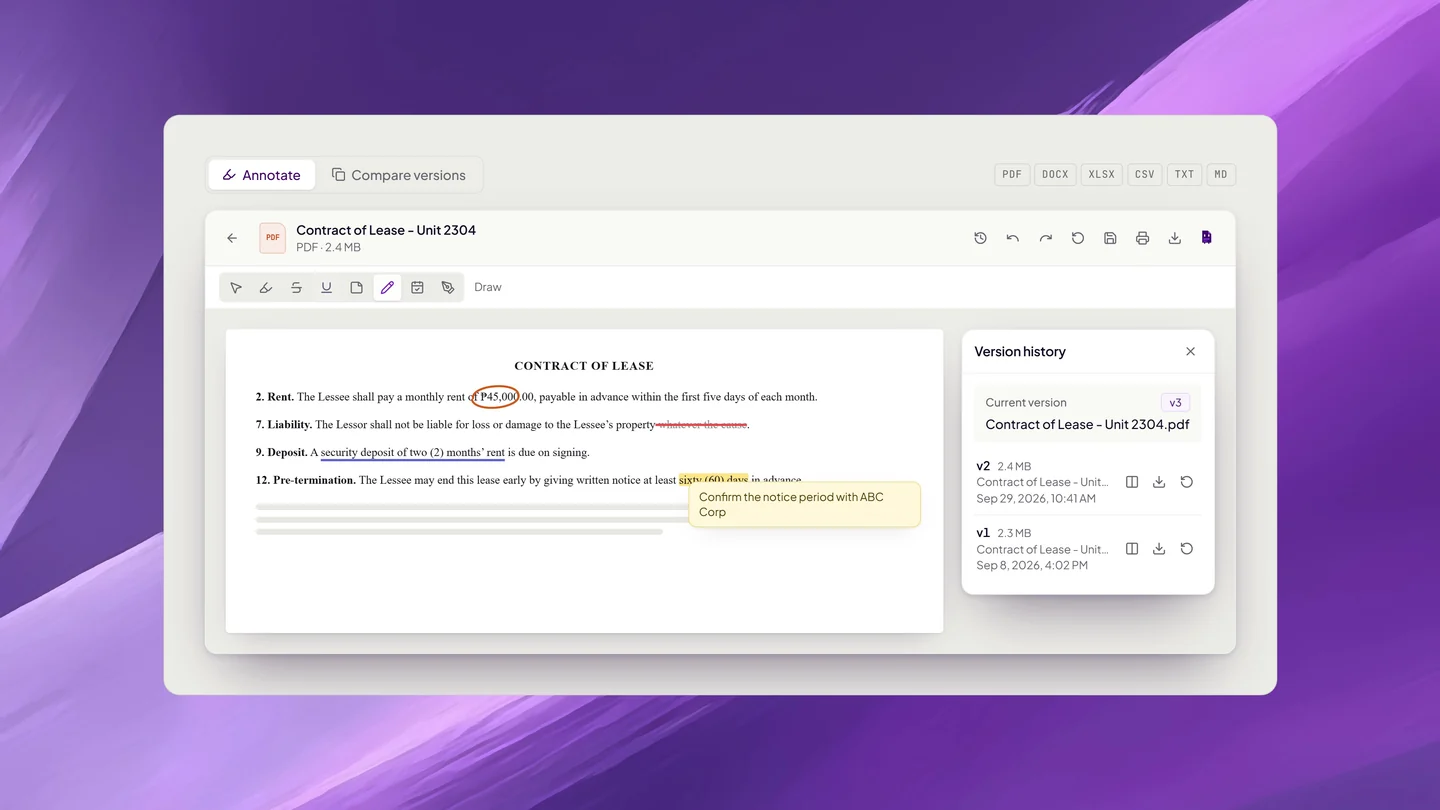
When Lex drafts or revises in Twala’s editor, it doesn’t write straight into the document. Each change arrives as a proposal showing what will change, and it goes in only when someone clicks Apply. Dismiss drops it. Edited files keep their earlier versions, two versions can be compared side by side, and colleagues can comment on a clause, reply in a thread, and resolve it once it is settled.
The draft can come from a machine. The decision to adopt each line should not.
4. Keep matters apart
A firm that handles two sides of a market, or two clients in the same industry, cannot have its AI blending one matter into another. Twala’s team workspaces are private until they are shared, every teammate gets no access, view access, or edit access item by item, and Lex follows the same rule. Owners and admins can also switch AI features on or off for each member, which is useful while a firm is still writing its own policy on who may use them and for what.
5. Use AI where it is strong, and stop where judgment begins
AI is good at first drafts built from templates and prior work, at summaries, and at finding the passage that answers a question. It is good at pulling dates, amounts, and parties out of a stack of agreements, especially when, as in Twala’s data extraction, every value is marked High, Medium, or Low confidence and can be corrected before anyone downloads it.
It is not good at judgment, and it shouldn’t be asked to supply it. Advising a client, weighing a line of decisions, deciding whether the person in front of a notary understands what they are signing and is signing freely: those calls belong to the lawyer. In an electronic notarization, the Electronic Notary Public still confirms identity and voluntariness, face to face or over live video, whatever the platform has checked beforehand. Technology can make that moment safer. It cannot stand in for the notary.
The policy work ahead
Individual habits will only go so far. The profession will need shared rules on how AI is used in legal work, and they are best written by lawyers who use the tools, with the people who build them in the room.
That is part of why Twala works with the profession on them. Under its national partnership with the Integrated Bar of the Philippines, Twala and the IBP have agreed on webinars, seminars, and training on digital legal tools for IBP members.
Writing about notarization, Twala co-founder Atty. Third Bagro put it simply: “Notarization is not an obsolete formality.” (You can read the full essay, The Last Mile of Digitalization.) Neither is a lawyer’s review. AI makes the work faster. It doesn’t make the lawyer optional.
To see how these principles show up in the product, read Meet Lex and AI legal research for Philippine lawyers, or review the safeguards on our security page.