The Electronic Notarial Register: How Notarial Books Work on Twala
On Twala, an Electronic Notary Public’s notarial register is kept as the work happens: each act is entered when it is sealed, filed with the Supreme Court, and gathered into a monthly notarial book.
In traditional practice the register is a bound book, written up by hand one entry at a time, and the notary answers for every page. For electronic acts, the Rules on Electronic Notarization (A.M. No. 24-10-14-SC) replace it with the Electronic Notarial Book, “a chronological official register of notarial acts in electronic form” (Rule VIII, Sec. 1). This is how that register works on Twala, and what still rests with the notary.
One book per facility
An ENP may use as many accredited Electronic Notarization Facilities (ENFs) as desired, but keeps one account, one Electronic Notarial Book, and one seal on each (Rule VII, Sec. 3). Everything below describes the book you keep on Twala.
When an entry is made
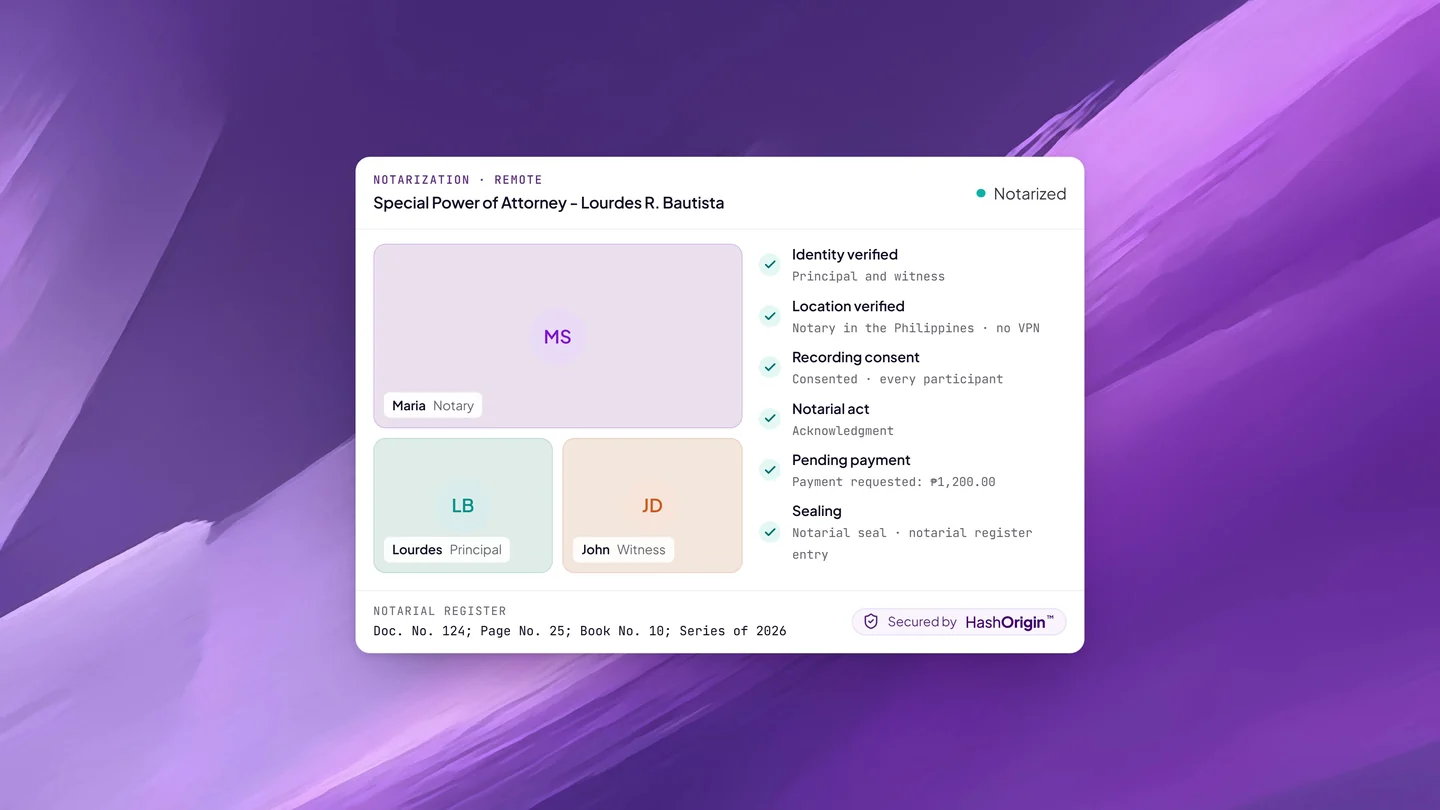
An act reaches the register at the end of its life, not the start. You perform the act and request payment, and the act reads Pending payment. Once the fee is paid it reads Sealing while Twala adds the notarial certificate page with your seal and a QR code, enters the act in your notarial register, and files it with the Supreme Court under your commission. Then it reads Notarized.
The Rules provide for the notarized document to be uploaded to the Supreme Court Central Notarial Database automatically (Rule IV, Sec. 7). On Twala that happens as soon as the act is sealed, with nothing for you to submit. The register and the sealed documents line up because the entry is made at the moment the document is sealed.
Reading a register line
The notarial certificate closes on a line like this one:
Doc. No. 124; Page No. 25; Book No. 10; Series of 2026
Doc. No. is the entry’s number, Page No. the page it sits on, and Series the year. Book No. follows the month, because on Twala each month of the register becomes its own notarial book: an act sealed in October goes into Book No. 10. Principals see the line on their notarized PDF. Witnesses see it on the notarization, even though they never see the document.
What an entry holds
An entry records the act and the people in it. For each principal and witness, that includes their name, their address, and the ID they verified with, which Twala collects only after the person consents. It also records the act you selected: acknowledgment, oath, affirmation, signature witnessing, or jurat.
Nothing is copied into a book by hand. Twala enters the act from the notarization itself, after you have confirmed every participant’s details in the session, which the checklist asks of you before you can request payment.
Who can see what
- You see the whole notarization, the document, and the register line, and you are the only person who can open a session recording.
- Principals can open the notarized document and download it from Notarizations whenever they need it.
- Witnesses see the notarization’s status, participants, and register details, but not the document. A witness who needs a copy uses Request copy and gives a purpose. You approve it, free or for a fee, or deny it with a reason, and an approved copy can be downloaded once.
Every notarization also keeps an activity log, so you can show what happened and when. Beyond the parties, the Rules let any person ask to inspect an entry by showing an ID and stating a purpose.
Keeping the book
Records are kept for the duration of your commission, or longer if a court directs (Rule XII, Sec. 2). The Rules have the ENP keep a duplicate of the Electronic Notarial Book (Rule VIII, Sec. 1), and they require every accredited ENF to back up notarial books in real time (Rule VII, Sec. 2).
On Twala, the database keeps a standby in sync, ready to take over, and the platform runs under formal Disaster Recovery and Business Continuity Plans, with continuous monitoring and documented incident response procedures. The notary’s own duty remains: if records are ever lost or compromised, the Rules require the notary to notify witnesses within 72 hours.
Why an electronic register is harder to abuse
Paper registers and rubber seals are easy to imitate. The Supreme Court said as much when it cleared lawyers accused of letting others misuse their notarial seals and registers, noting how easily third parties can fake seals and stamps.
On Twala, your seal is drawn from your name and roll number, and Twala adds it only to an act performed on your account, after its fee is paid. The account is protected by identity verification, optional two-factor authentication, and a rule of one sign-in at a time, and the audit log is kept with HMAC-SHA256 integrity checks. Each sealed PDF carries a digital signature and is anchored on a blockchain with HashOrigin™ technology, so a copy that has been altered shows as Document tampered on Twala’s verify page, and a document Twala never sealed has no record to match. Our guides to verifying an eNotarized document and to HashOrigin and blockchain anchoring explain those checks from the recipient’s side.
Frequently asked questions
When is an act filed with the Supreme Court?
As soon as it is sealed, which happens once the fee is paid. The filing is automatic and is made under your commission.
Do I keep a separate book on each facility I use?
Yes. The Rules give an ENP one account, one Electronic Notarial Book, and one seal on each accredited ENF.
Can witnesses see the notarized document?
No. Witnesses see the status, the participants, and the register details. They can ask for a copy with Request copy, and you decide.
Why does the Book No. change every month?
Because each month of the register becomes its own notarial book on Twala. Book No. 10 is October.
To see the register at work through a full day, read a day in an ENP’s practice on Twala, and for the sessions that feed it, running a good remote notarization session. Not yet commissioned? Start with how to become an Electronic Notary Public, see our eNotary overview, or read the complete guide to eNotarization in the Philippines.
Twala is a Supreme Court-accredited Electronic Notarization Facility (ENF). Twala is a technology provider and does not give legal advice. Notarial acts are performed by commissioned Electronic Notaries Public.