A Day in an Electronic Notary Public’s Practice on Twala

Here is an illustrative workday for an Electronic Notary Public (ENP) on Twala, from the requests that arrive overnight to the payouts and credits at the end of the day.
Atty. Maria Clara Santos is not a real notary. She is the example ENP in Twala’s product screens, and the day below is made up. The screens, status words, and rules in it are real.
She practices in Iloilo City. A traditional commission confines a notary to the territory of the court that issued it. As an ENP, Maria can notarize for principals anywhere in the Philippines, in person or over video, through an accredited facility.
7:30 a.m.: What came in overnight
Twala is open 24/7, so requests arrive whenever clients send them. Three are waiting under Appointments, each marked Awaiting review.
The first is a contract of lease between a landlord in Iloilo City and a tenant in Bacolod, booked as Remote. Both parties signed it on Twala through an envelope last night, which suits the act: for an acknowledgment, a principal may sign before the session and confirm to the notary that the signature is theirs.
The second is a special power of attorney from a mother in Roxas City, authorizing her daughter to deal with a bank on her behalf. Remote, one witness, also an acknowledgment.
The third is a notarial will. Notarial wills are outside electronic notarization and stay under the 2004 Rules on Notarial Practice, so Maria explains that in the request’s Messages tab, then declines it.
The SPA’s Messages tab has a question waiting: does the witness need an account? Yes, Maria writes: a free Twala account under the email the witness was added with, and a current identity verification. Messages don’t trigger an email, but the red dot will tell the principal there is a reply.
She accepts the lease and the SPA. Both now read Confirmed.
9:00 a.m.: A remote acknowledgment
Maria opens the lease appointment and clicks Join session. Her own location is checked first, as everyone’s is. The Rules require her to confirm through geolocation that all parties are in the Philippines, and the location check is how she does it. The landlord joins, then the tenant, each admitted by a location check and listed beside the call as In session.
She asks to record. The session bar reads Waiting for consent until both agree, then Recording. Had either of them declined, the session would have gone on without a recording.
She takes each party through the basics: who they are, against the verification on file; whether they read the lease; and whether the signatures on it are theirs, made of their own free will. She selects Acknowledgment, and the checklist beside the call fills in. Participants: All details are confirmed. Notarial act: Acknowledgment. Remote session: A participant joined the session with you. Location: Your location is confirmed.
She sets her fee and requests payment. One credit is spent, and the act reads Pending payment. The landlord pays online with Pay a few minutes later, and the act moves to Sealing, then Notarized. Twala has added the certificate page with her seal and its QR code, entered the act in her notarial register, and filed it with the Supreme Court. The register line says Book No. 10. On Twala each month is its own book, and this is October’s.
Nothing was stamped, photocopied, or written into a register by hand.
10:30 a.m.: The act she denied
A man in Kalibo, booked last week, joins to sign and swear to an affidavit. For a jurat, the Rules have the principal sign and take an oath before the ENP as part of the act, so Maria starts by asking him to explain the affidavit in his own words. He looks away from the camera twice before answering. Then a voice off-screen starts answering for him.
She asks him to show the room. He won’t. Maria denies the act. It costs her nothing, since a credit is spent only when payment is requested, and the notarization reads Denied. He can book again when he can appear and speak for himself.
Under the Rules, appearing by videoconference is the equivalent of appearing in person. The duty that comes with it is unchanged: the notary still has to be satisfied that the person understands the document and is acting freely. A man who cannot answer for himself has not appeared in any sense that counts.
Noon: A question for Lex
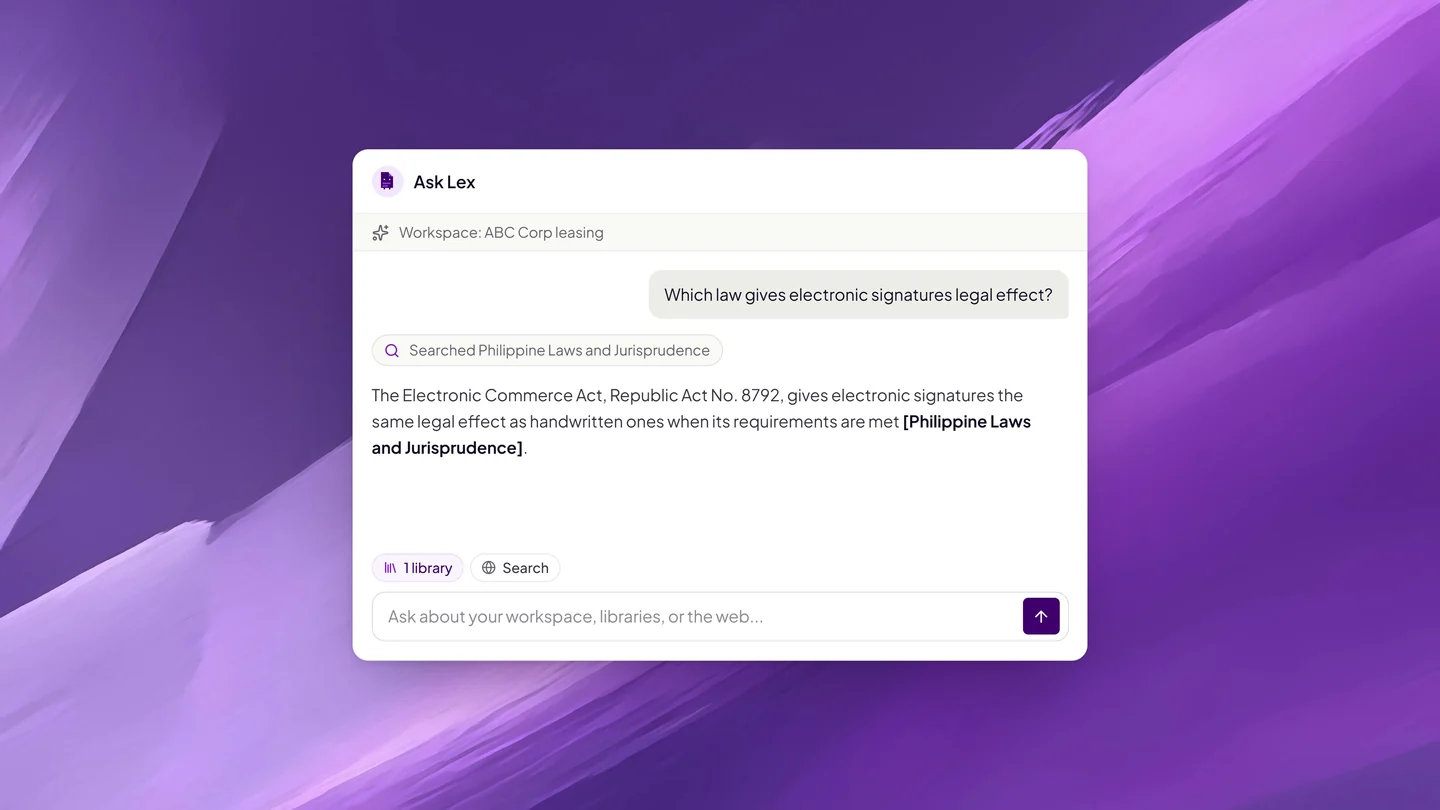
Between sessions, a corporate client asks whether a board resolution gives its corporate secretary enough authority to sign a deed for the company. Maria opens Ask Lex with the Philippine Laws and Jurisprudence library switched on and asks for the rules and the leading decisions on corporate officers signing for a corporation.
Lex reads her files first, then the library, and its answer names the decisions and the library it drew on. She reads the sources before she replies to the client. Lex shortens the search. The opinion is still hers.
2:00 p.m.: In person, still electronic
An elderly client prefers to come to the office, so this appointment is booked as In-person; for those, the notary arranges where to meet. The client verified her identity and signed her deed of donation on Twala the day before. Today she sits across Maria’s desk, confirms that the signature is hers, and the act runs the way the morning’s did: acknowledgment, payment request, seal, register entry, filing. She pays with Pay on her phone before she leaves.
In person or over video, an electronic act ends in the same sealed PDF.
3:30 p.m.: A dropped call
Ten minutes into the SPA session, the mother in Roxas City freezes, then drops out. Maria waits. The mother opens the same link again, reappears beside the call as In session, and they pick up where they stopped. Had the session already ended, Maria could have started a new one, and everyone would have been told by email and in Twala.
The SPA is acknowledged with the witness present, and the fee is paid within the hour.
4:30 p.m.: A copy request
A witness to a deed of sale that Maria notarized two weeks ago sends a request through Request copy, giving his purpose: he wants it for his records. A witness sees a notarization’s status, participants, and register details, never the document itself, so a copy has to be asked for. Maria approves it at no charge, and he can download it once.
5:30 p.m.: Payouts and credits
Maria checks Payouts. Fees paid online reach her e-wallet on the schedule she chose, every two weeks in her case, less withholding tax and payment gateway fees. Her credits are down to three, so she buys the ₱2,000 package of 26 credits, plus VAT. Credits never expire, so a quiet week costs her nothing. The full economics are in why Electronic Notaries Public choose Twala.
October’s register, Book No. 10, now holds the day’s acts, each already filed with the Supreme Court. At the end of the month it closes as October’s notarial book.
After hours
Requests keep arriving after she logs off, because Twala doesn’t close. Clients can verify their identity, sign, and send requests at any hour, and they book from the open times Maria has set for tomorrow. She will read them at 7:30.
If you are an ENP, or about to become one, start with how to become an Electronic Notary Public, then read our guides to running a good remote session and how notarial books work on Twala. When you are ready, apply as an ENP on Twala. For the principal’s side of the same day, see our complete guide to eNotarization in the Philippines.
Twala is a Supreme Court-accredited Electronic Notarization Facility (ENF). Twala is a technology provider and does not give legal advice. Notarial acts are performed by commissioned Electronic Notaries Public.