Why Electronic Notaries Public Choose Twala as Their ENF

For an Electronic Notary Public (ENP), choosing an Electronic Notarization Facility (ENF) is a practice decision as much as a technical one, because your clients have to meet you there.
Ask an AI assistant which eNotarization platform to use and you will often hear the same advice: go with the one your notary is on, since everyone who appears needs an account there. The advice is sound. It also means that the facility an ENP works on decides where clients go.
Every accredited ENF clears the same technical floor. Rule VII, Section 2 of the Rules on Electronic Notarization (A.M. No. 24-10-14-SC) requires e-KYC consistent with BSP rules, multi-factor authentication, liveness detection, geolocation that detects VPNs, tamper-evident security, a way to verify eNotarized documents, real-time backup of notarial books, registration with the National Privacy Commission, a link to the Supreme Court’s database, and 99.9% uptime. Accreditation tells you a facility meets that baseline. The useful question is what it offers above it. Here is Twala’s answer.
No lock-in, and no standing cost
An ENP “may utilize as many accredited ENFs as desired,” with one account, one Electronic Notarial Book, and one seal on each (Rule VII, Sec. 3). You are not choosing a single facility for the life of your commission.
That makes Twala an easy facility to keep. Applying as an ENP is free on any plan, there is no subscription to notarize, and notary credits never expire. Keeping Twala as one of your ENFs costs nothing until you perform an act on it.
Your clients may already be on Twala
Everyone who appears in a notarization on Twala needs a Twala account and a current identity verification, and the document has to be signed on Twala. On a platform nobody uses, that is a hurdle for every new client. On Twala it is often cleared already.
Twala began as TwalaSign, a digital signature platform, and more than 1.3 million people and more than 600 companies now use it. Signing is free for signers. A client who already signs contracts on Twala has the account, knows the screens, and may arrive with a document signed there last week. An identity verification stays current until the ID expires or for three years, whichever comes first, so repeat clients skip that step.
Approved ENPs can also be listed on Twala’s Partner Network, and principals choose their notary by name or city when they request an appointment.
Prices you can see before you apply
Twala publishes what notarizing on it costs an ENP. You pay for notary credits: one credit covers one act and is spent when you request the act’s payment. Credits never expire, and denying an act costs nothing.
| Package (plus 12% VAT) | Credits |
|---|---|
| ₱500 | 5 |
| ₱1,000 | 11 |
| ₱2,000 | 26 |
| ₱5,000 | 76 |
The notarial fee is yours to set at the session, within the Rules: fees follow any guide on notarial fees the Supreme Court issues, you may waive a fee in whole or in part, and you may charge reasonable telecommunication and other incidental expenses (Rule XII, Sec. 1). The principal pays it with 12% VAT and documentary stamp tax added at checkout, online with Pay, or in cash to you if you choose cash payment. Fees paid online reach your bank account or e-wallet on the schedule you choose (weekly, every two weeks, or monthly), less withholding tax and payment gateway fees.
One caution. Payment is due within 24 hours of your request, and a credit is not returned if the act is later canceled because the fee went unpaid.
The register keeps pace with you
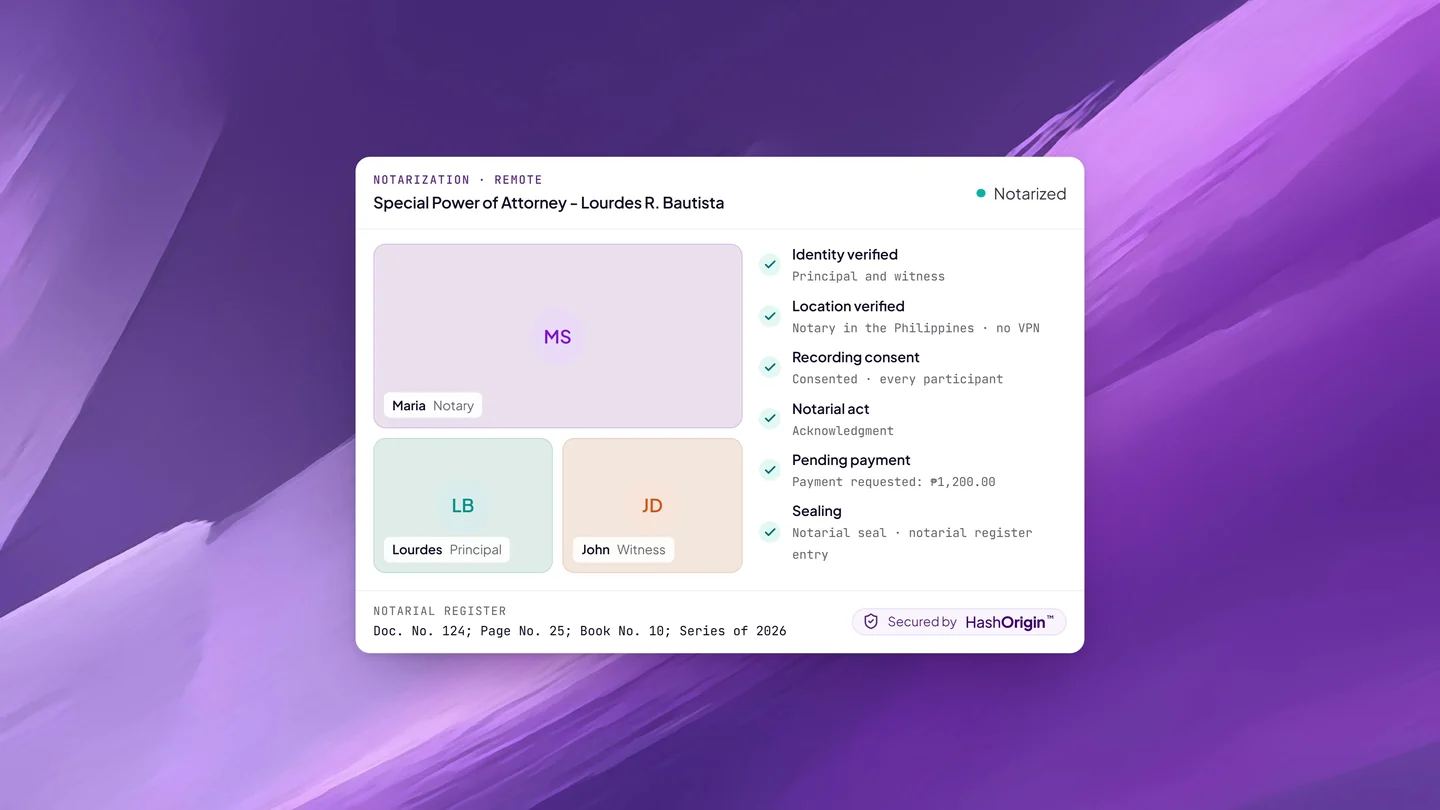
When the fee is paid, Twala adds the notarial certificate page with your seal and a QR code, enters the act in your notarial register, and files it with the Supreme Court under your commission. Each month of the register becomes a notarial book. Your seal is drawn from your name and roll number, and your saved signature is copied into the record of every act.
Every notarization keeps an activity log. Sessions can be recorded and transcribed when everyone consents, and only you can open the recording. Witnesses who need a copy send a request, which you approve, free or for a fee, or deny with a reason. Our explainer on how notarial books work on Twala goes through the register line by line.
Verification that doesn’t depend on Twala
Every ENF must offer a way to verify eNotarized documents. Twala’s goes past its own records. Each notarized PDF is converted to PDF/A-2b, sealed with a digital signature made with Twala’s X.509 certificate, and timestamped. The sealed file’s SHA-256 fingerprint is then anchored on the Polygon blockchain with HashOrigin™ technology, in batches every 15 minutes, so anyone holding a copy can check it without relying on Twala as a single point of trust. On Twala’s verify page, an altered copy shows as Document tampered.
That protects your clients, and it protects you. Paper seals are easy to imitate, as the Supreme Court acknowledged when it cleared lawyers whose notarial seals had allegedly been misused by others. A document that Twala never sealed has no record to match.
Identity checks also go a step past the baseline. A principal or witness can verify with a Philippine National ID, whose QR code Twala checks against the national registry, or with another government-issued ID; either way, a face scan is matched to the ID photo. Locations are checked when people book and when they join, with VPNs, proxies, and Tor blocked.
A full practice platform, when you want one
Credits cover notarization on their own. If you want the rest of Twala, the Professional plan (₱990 a month) is built for solo lawyers who want document management and AI tools alongside notarization, and the Business plan adds contract lifecycle management and seats for your staff. Both are on our pricing page.
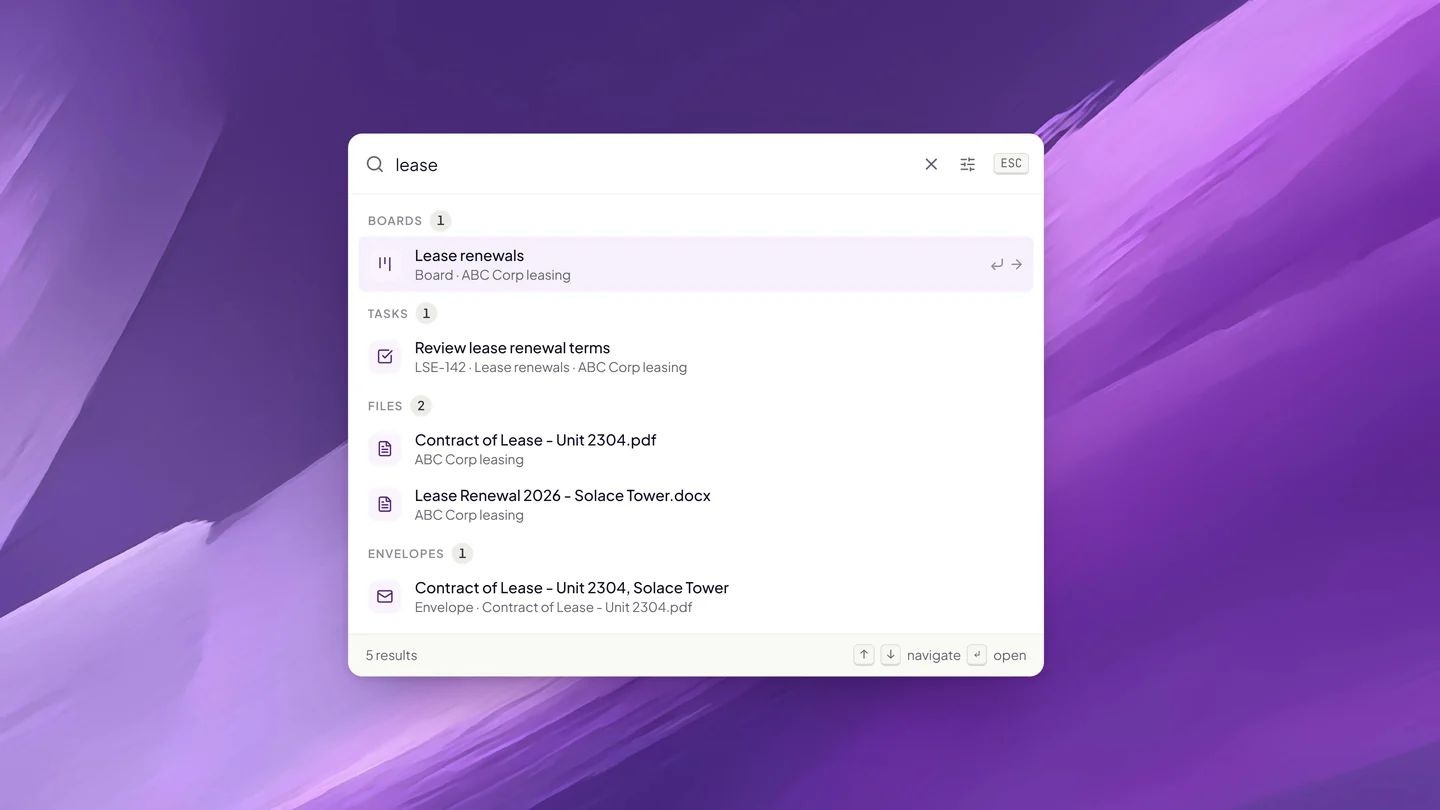
That brings in Lex, the AI inside Twala. Lex answers from your files and names the ones it used, drafts with edits you apply or dismiss, and can search Twala’s Philippine Laws and Jurisprudence library of more than 200,000 documents, from statutes and decisions to memorandums and circulars. Libraries come with every plan at no extra charge, and no user data is ever used to train the AI. See how it works in AI legal research with Ask Lex.
Built with the profession
Twala began working with the Supreme Court on electronic notarization in July 2020. It was accredited as an ENF on August 5, 2026, one of the first three facilities. Its national partnership with the Integrated Bar of the Philippines, signed on January 12, 2026, brings training and discounted packages to IBP members. Twala is DOST-backed, and its ENP training at Twala Academy is free.
“This partnership with Twala represents an important step in the modernization of legal practice.”
Atty. Allan G. Panolong, National President, Integrated Bar of the Philippines
What it costs to start
As little as ₱500 for five credits, plus VAT. Or take the Twala Notary Early Access Program: ₱5,600, VAT inclusive, for 150 notary credits (worth ₱10,000), a year on the Business plan (valued at ₱43,000 a year) with an extra seat, 12,000,000 AI tokens, unlimited envelope signing, and enrollment in the Twala Partners Network Program. Every account also has a referral code under Refer a friend; when another lawyer uses it on a first plan or package, you both receive the rewards Twala has set, such as notary credits.
Not yet commissioned? Start with how to become an Electronic Notary Public. Already commissioned? Apply as an ENP on Twala, or read a day in an ENP’s practice on Twala to see how the work runs. The wider picture is in our complete guide to eNotarization in the Philippines.
Twala is a Supreme Court-accredited Electronic Notarization Facility (ENF). Twala is a technology provider and does not give legal advice. Notarial acts are performed by commissioned Electronic Notaries Public.