What eNotarization Means for the Philippine Legal Profession

For the Philippine legal profession, eNotarization means a notarial practice no longer bound to one city, a register that keeps itself, and a new commission that comes with duties of its own.
Notarization has always been a lawyer’s work in the Philippines, and the Rules on Electronic Notarization (A.M. No. 24-10-14-SC) keep it that way. What they change is where a lawyer can notarize, how each act is recorded, and how much of the paper trail a forger can fake. Since electronic notarization officially launched on October 19, 2026, none of this is theoretical anymore.
A practice no longer tied to one city
Under the 2004 Rules on Notarial Practice, a notary public may notarize only within the territorial jurisdiction of the commissioning court. A lawyer commissioned in Quezon City could not notarize for a client in Iloilo, so the client found someone local or made the trip.
The new Rules lift that limit for Electronic Notaries Public (ENPs). An ENP can notarize for parties anywhere in the Philippines, as long as everyone appears from within the country and the act runs through an accredited Electronic Notarization Facility (ENF). Appearance by videoconference is the equivalent of physical appearance under the Rules, so a remote session needs no shared room, only a live audio-video call that everyone joins from their own device.
The lawyers who gain the most practice outside Metro Manila. A practitioner in Legazpi or Tacloban can now take an affidavit from a client in Davao, or notarize a deed for co-owners in Baguio and Cebu in a single session. On Twala, people requesting a notarization pick an ENP by name or by city, so a provincial practice becomes visible to clients it could never reach before.
That also means competition. A client who used to go to whichever office was nearest the city hall can now choose, and responsiveness, clear fees, and a careful manner on camera will count for as much as location once did.
A separate commission, with obligations of its own
An electronic notarial commission is not an add-on to a traditional one. Lawyers apply for it separately through the Supreme Court, and the requirements reflect the weight of the role: good standing with clearances from the Office of the Bar Confidant and the IBP, compliance with Mandatory Continuing Legal Education (MCLE) and the Unified Legal Aid Service (ULAS), at least a year of residence in the Philippines, and a regular place of work or business here.
The application carries a ₱3,000 fee paid through the Judiciary ePayment System, proof of training on an accredited ENF, an initial assessment, a virtual summary hearing, and a second evaluation before the Court issues a two-year commission. Renewal is filed within 30 days prior to the commission’s expiration. Miss it, and the lawyer is automatically removed from the Directory of ENPs, which shuts off access to every ENF at once.
An ENP may use as many accredited ENFs as they like, with a separate account, Electronic Notarial Book, and seal on each. Every accredited facility has to meet the same technical baseline set by the Rules, so the choice between them comes down to what each one offers above it.
None of this is a formality. A lawyer who notarizes online answers for each act exactly as one who notarizes on paper. Our guide on how to become an Electronic Notary Public walks through each step, and our ENP application FAQs cover MCLE, ULAS, renewal, and what newly admitted lawyers can submit.
A register that keeps itself
Every notary knows the paper notarial register: entries written by hand, act by act, with the document, page, and book numbers that tie a notarized instrument to its record. A missed or mismatched entry is easy to make and hard to explain later.
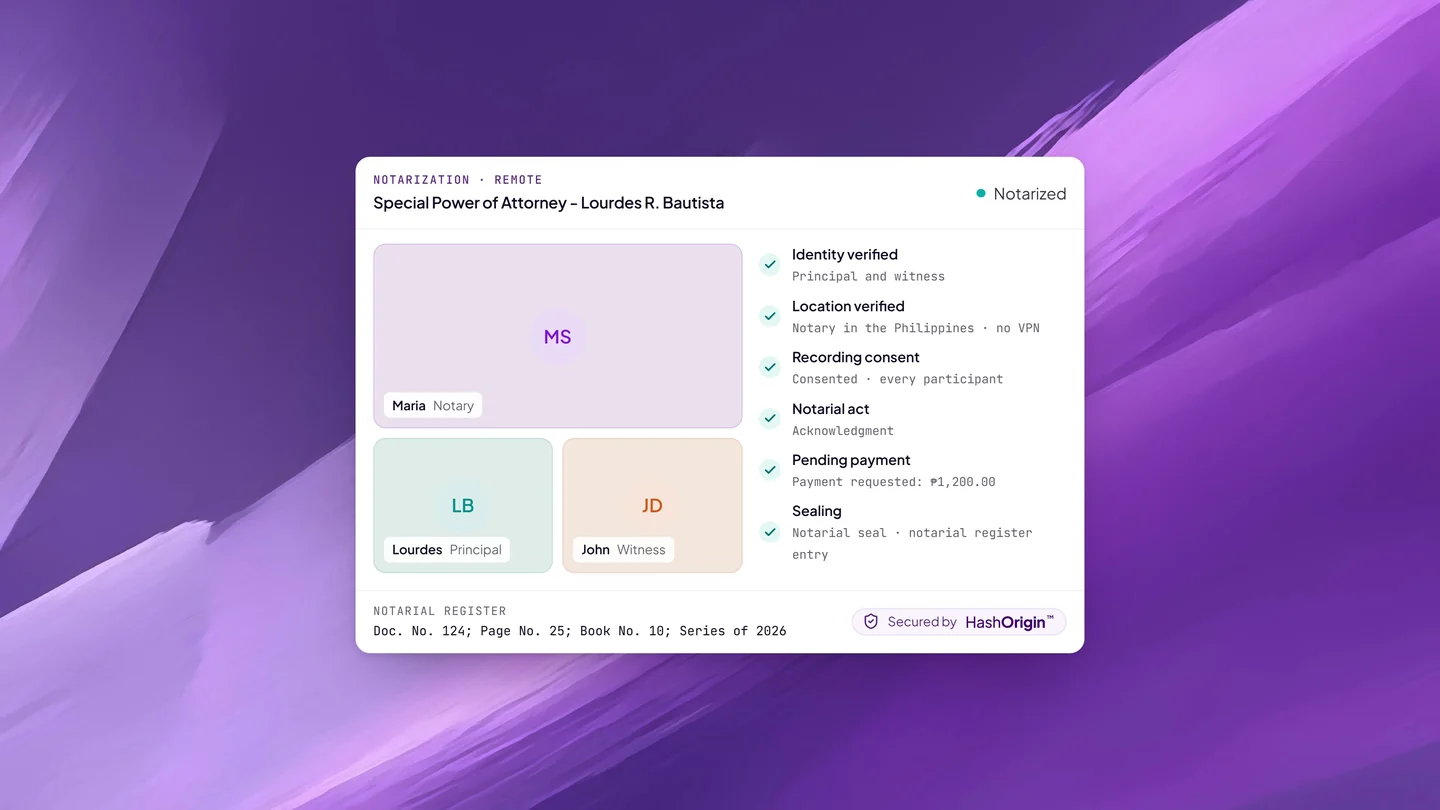
Under the new Rules, the Electronic Notarial Book is a chronological official register of notarial acts in electronic form, and each notarized document is uploaded automatically to the Supreme Court’s Central Notarial Database. On Twala, the entry is part of the act. Once an act is sealed, it goes into the notary’s register with its document, page, book, and series numbers and is filed with the Supreme Court under the notary’s commission, and each month of the register becomes a notarial book. Every notarization also keeps an activity log of what happened and when. The details are in how notarial books work on Twala.
Fewer ways to forge a notary
Paper notarization has a weakness the profession knows well: a seal and a signature can be copied. In A.C. No. 11889, a case connected to the Malampaya Fund scandal, documents allegedly bore forged notarial seals and signatures of three lawyers. The Ombudsman accused them of letting others use their seals and registers. The Supreme Court found no clear proof that they had consented, and it recognized how easily third parties can make fake seals and stamps. We wrote about the case in what the fraudulent-seal rulings show.
Electronic notarization takes away most of what a forger needs. On Twala, the notarial certificate and seal are added by the platform, only after an act the ENP performed in a session where every principal and witness was identity-verified, and only once the fee is paid. The finished PDF is sealed with a digital signature and anchored on a blockchain with HashOrigin™ technology, so a seal copied onto another file carries none of that proof, and any change to a notarized document shows as Document tampered when it is verified. ENPs can protect their own accounts with two-factor authentication, and a new sign-in ends any earlier session.
The pandemic workaround is gone
During the COVID-19 pandemic, the Supreme Court’s 2020 Interim Rules on Remote Notarization of Paper Documents (A.M. No. 20-07-04-SC) let notaries notarize paper documents with parties appearing by videoconference. The Rules on Electronic Notarization repealed them. A notary on an ordinary video call, stamping a paper document, is no longer an option. Remote notarization now means an electronic document, a commissioned ENP, and an accredited ENF.
Legal aid without the commute
ULAS compliance is part of the eligibility for an electronic notarial commission, and eNotarization makes legal aid easier to deliver. One of the two documents notarized at the October 19 launch was an agreement with the IBP under which participating lawyers give free online consultations to eligible beneficiaries using Twala, subject to the program’s intake and scheduling, and Twala provides free eNotarization credits for eligible indigent clients. The Rules also let an ENP waive the notarial fee in whole or in part. A lawyer can now help a client three provinces away without either of them losing a day to travel. More in our post on the IBP and Twala legal aid program.
What does not change
Personal appearance is still the heart of the act, whether physical or by live audio-video through an accredited facility. The notary must still be satisfied about who is appearing and that they understand the document and sign it freely. An ENP can still refuse, and on Twala denying an act costs the notary nothing. On Twala, a remote session is recorded only with everyone’s consent, and the Rules strictly prohibit pre-recorded videos of the principal and witnesses signing.
Some instruments stay on paper altogether. Notarial wills and depositions remain under the 2004 Rules, as do paper documents with wet signatures that must stay on paper.
And the presumption that makes notarization valuable, that a notarized document was regularly and duly executed, still depends on the notary doing the work properly. We look at that presumption in why a notarized document carries weight.
Where the profession goes from here
The Electronic Commerce Act anticipated electronic notarization in 2000. The rules came in 2025; accredited facilities and commissioned ENPs followed in 2026. The tools are in place. What remains is for lawyers to take the commission, learn a facility, and bring their clients along.
Twala has worked on this with the legal community for years, from input to the Supreme Court beginning in July 2020 to a national partnership with the IBP signed in January 2026, which brings webinars, training, and discounted packages to the IBP’s more than 50,000 lawyers. Lawyers who want to start can take the free course at Twala Academy, which meets the Supreme Court’s training requirement for ENP applicants, then apply as an ENP on Twala.
Twala is a Supreme Court-accredited Electronic Notarization Facility (ENF). Twala is a technology provider and does not give legal advice. Notarial acts are performed by commissioned Electronic Notaries Public.