Why a Notarized Document Carries Weight, on Paper or Online

A notarized document carries weight in the Philippines because notarization turns a private document into a public one: admissible in court without further proof of its authenticity, and presumed regular.
That holds for a deed notarized on paper decades ago and for a PDF notarized on Twala today. Under the Rules on Electronic Notarization (A.M. No. 24-10-14-SC), an electronic notarial act performed through an accredited facility has the same validity, force, and effect as a traditional one. To see why the new rules were written the way they were, it helps to start with what notarization does.
Private documents have to be proved
Philippine rules of evidence sort documents into public and private. A private document, such as a contract two people sign at a kitchen table, can be perfectly valid. But before a court relies on it, someone has to prove that it was signed by the person who appears to have signed it, and if that person denies the signature, the case can turn on witnesses and handwriting.
A public document needs no such proof. Notarization is one of the ways a private document becomes public: the notary’s certificate stands in for the testimony that would otherwise be needed.
The presumption of regularity
A notarized document is entitled to full faith and credit on its face. Courts presume that it was regularly executed, that the signatures on it are authentic, and that it was duly executed by the people named in it. The presumption is strong. It gives way only to clear and convincing evidence, a heavier burden than the ordinary standard in civil cases.
A great deal rides on that presumption. The Civil Code requires certain contracts to appear in a public document, most notably those involving rights over real property. Government offices, banks, and courts ask for notarized affidavits, powers of attorney, corporate certificates, and loan papers because a notarized document lets them act without investigating every signature themselves. More than 40 document types commonly require notarization in the Philippines.
What the notary actually vouches for
The presumption is only as good as the act behind it, and the act is narrower than many people assume. A notary does not certify that a document’s contents are true. The notary confirms that the person signing appeared, that their identity was established, and that they understood the document and signed it voluntarily. For a jurat, the person also swears or affirms to the truth of the document before the notary.
Atty. Third Bagro, Twala’s co-founder and General Counsel, put it in one line in The Last Mile of Digitalization: “Notarization is not an obsolete formality.” It is how the legal system checks identity and consent before it extends its trust to a document.
What the Rules on Electronic Notarization kept
Read with that in mind, the 2025 Rules are conservative in the right places.
- Personal appearance. The principal and any witnesses appear before the Electronic Notary Public (ENP), either physically or by videoconference, which the Rules treat as the equivalent of physical appearance. Everyone has to be in the Philippines, and the ENP confirms it through geolocation. The one exception is a principal abroad who appears from inside a Philippine embassy, consular office, or Honorary Consul office, with an officer there confirming their presence. Even then, the ENP must be in the Philippines.
- Identity. The ENP relies on competent evidence of identity, starting with at least one valid government-issued ID such as the PhilID, checked through multi-factor authentication and liveness detection.
- A signature tied to the act. For an acknowledgment, the principal signs through the facility in the ENP’s full view, or confirms to the ENP that the signature already on the document is theirs. For a jurat, the principal signs and takes an oath before the ENP. For signature witnessing, the principal signs in the ENP’s full view.
- A register. Every act goes into the Electronic Notarial Book, a chronological official register of notarial acts in electronic form.
- A lawyer commissioned by the Court. The act stays in the hands of an ENP commissioned by the Supreme Court.
What changed
The medium changed, and the safeguards around the act grew with it. Each notarized document is uploaded automatically to the Supreme Court’s Central Notarial Database. A remote session may be recorded, while pre-recorded videos of the principal and witnesses signing are strictly prohibited. And the document carries its own proof instead of relying on ink.
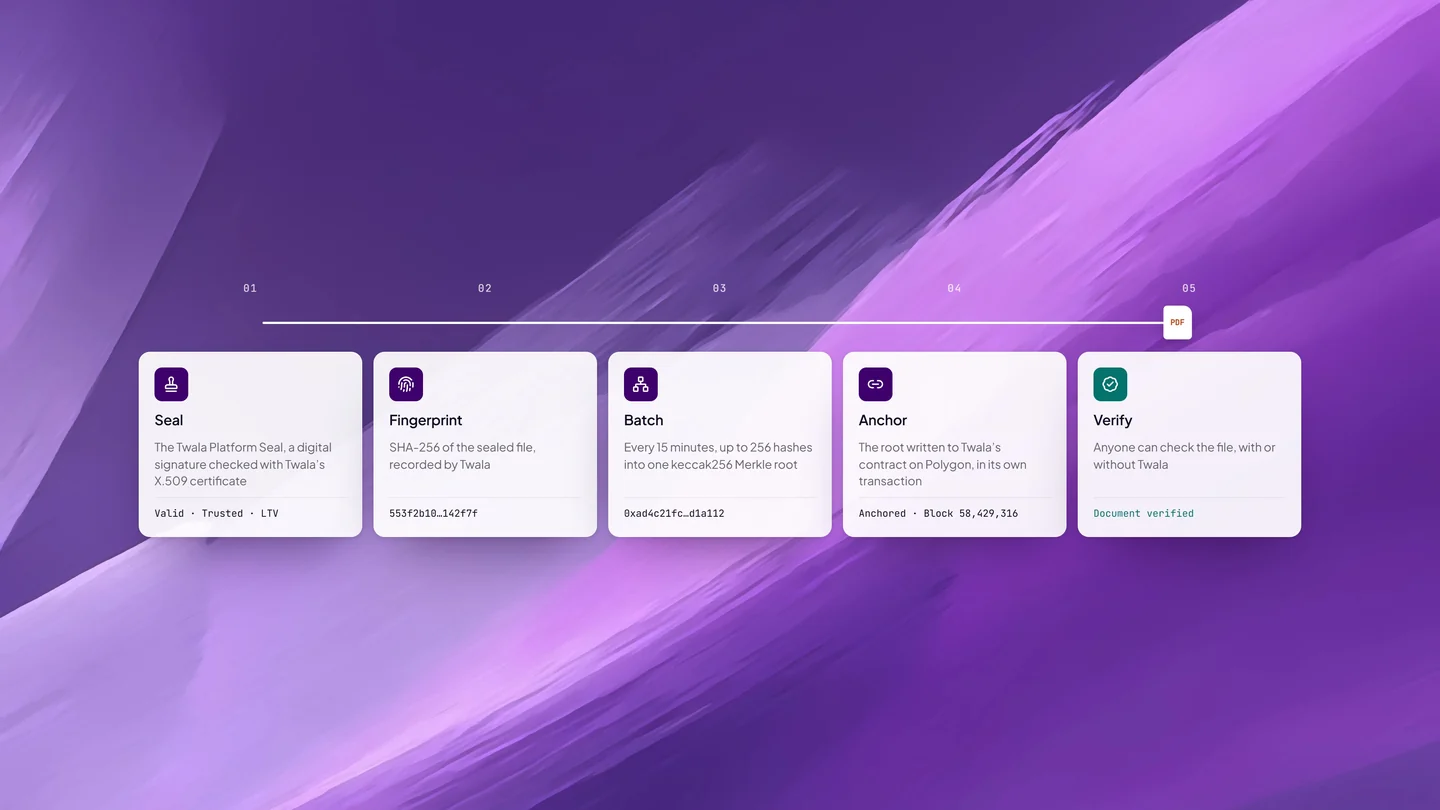
On Twala, that proof looks like this: identity verified with a Philippine National ID checked against the national registry, or another government-issued ID, then a face scan; a location check that blocks VPNs, proxies, and Tor; recording only with everyone’s consent; and a notarized PDF with a notarial certificate page, the notary’s seal, and a QR code, sealed with a digital signature and anchored on a blockchain with HashOrigin™ technology.
Why paper was the weak link
A paper notarization’s proof is a stamp and a signature, and both can be copied. In A.C. No. 11889, the Supreme Court recognized how easily third parties can make fake notarial seals and stamps. A register kept by hand can be incomplete. A photocopy of a notarized deed says nothing about whether the original was altered.
An eNotarized document answers those questions from the file itself. Anyone holding a PDF notarized on Twala can check it on the verify page, which compares the document’s fingerprint with Twala’s records and its anchor on the Polygon blockchain. If anything has changed since notarization, it shows as Document tampered. Our guide on how to verify an eNotarized document covers the steps.
The same weight, easier to check
The weight of a notarized document comes from a lawyer commissioned by the courts confirming that the right person signed, knowingly and freely. Paper only recorded that confirmation, and not very securely. An eNotarized PDF records the same confirmation in a form anyone can check, years later, without taking anyone’s word for it.
Frequently asked questions
Is an eNotarized document a public document?
Under the Rules on Electronic Notarization, an electronic notarial act performed through an accredited Electronic Notarization Facility has the same validity, force, and effect as a traditional notarial act, so an eNotarized document carries the same weight as one notarized on paper.
Does notarization prove that a document is true?
No. The notary confirms who signed and that they signed knowingly and voluntarily. A notarized document is presumed regular, not proven true, and clear and convincing evidence can overturn the presumption.
Can a notary still notarize a paper document over a video call?
No. The 2020 interim rules that allowed paper documents to be notarized with parties appearing by videoconference were repealed by the Rules on Electronic Notarization. An ordinary video call is not eNotarization: remote notarization now means an electronic document, a commissioned ENP, and an accredited facility. See eNotarization vs. traditional notarization.
Can I still notarize paper documents?
Yes, in person. Paper documents with handwritten signatures are still notarized under the 2004 Rules on Notarial Practice, and notarial wills and depositions stay under those rules.
To notarize a document online, start with our step-by-step guide or the Get notarized page.
Twala is a Supreme Court-accredited Electronic Notarization Facility (ENF). Twala is a technology provider and does not give legal advice. Notarial acts are performed by commissioned Electronic Notaries Public.