eNotarization vs. Traditional Notarization: What Changes and What Stays the Same

eNotarization and traditional notarization carry the same legal weight in the Philippines. What changes is how you appear, how you sign, and how anyone can prove the act afterward.
Most of us know the old routine by heart. Print the document. Find a notary’s office near the city hall. Wait your turn, sign in front of the lawyer, pay, and leave with a dry seal on the last page and your entry written into a thick notarial book. For two decades, the 2004 Rules on Notarial Practice built everything around that paper. The one detour came during the pandemic, when the 2020 Interim Rules on Remote Notarization of Paper Documents (A.M. No. 20-07-04-SC) let parties appear by video for paper documents.
The Rules on Electronic Notarization (A.M. No. 24-10-14-SC) took effect in March 2025 and repealed those interim rules. The new rules didn’t throw out the old routine. They kept its purpose and moved its mechanics online.
What stays the same
The legal effect
An electronic notarial act performed through an accredited Electronic Notarization Facility (ENF) has the same validity, force, and effect as a traditional one. Either way, notarization turns a private document into a public one. It becomes admissible in evidence without further proof of its authenticity, and it is presumed regular unless someone overturns it with clear and convincing evidence. That presumption is the reason banks, courts, and agencies ask for notarized documents at all. We go into it in why a notarized document carries weight.
The notary is still a lawyer
Only members of the Philippine Bar commissioned by the Supreme Court can notarize. An Electronic Notary Public (ENP) holds an electronic notarial commission, valid for two years, which a lawyer applies for separately. A traditional commission doesn’t turn into one on its own.
You still have to appear
Personal appearance survives. In in-person electronic notarization (IEN), you meet the notary face to face. In remote electronic notarization (REN), you appear in a live audio-video session, which the Rules treat as the equivalent of appearing in person. It has to be live: pre-recorded videos of principals and witnesses signing are strictly prohibited. Either way, the notary confirms who you are, that you understand the document, and that you are signing it freely. As Atty. Third Bagro, Twala’s co-founder and general counsel, wrote in The Last Mile of Digitalization: “Notarization is not an obsolete formality.”
Every act is recorded
Each act still goes into a chronological register, under the same document, page, book, and series numbers lawyers have always used. The Rules call it the Electronic Notarial Book, and the ENP keeps a duplicate of it.
What changes
| Aspect | Traditional notarization | eNotarization on Twala |
|---|---|---|
| Rules | 2004 Rules on Notarial Practice | Rules on Electronic Notarization (A.M. No. 24-10-14-SC) |
| The document | Paper | PDF, sealed as PDF/A-2b once notarized |
| Signatures | Wet ink | Twala’s secure digital signature |
| Where you appear | The notary’s office | A live video session from anywhere in the Philippines, or in person |
| The notary’s reach | The territory of the commissioning court | Nationwide |
| Identity check | The notary inspects your ID | National ID checked against the registry, or a government ID, plus a face scan |
| Location | You’re in the notary’s office | Checked when you book and when you join; VPN, proxy, and Tor blocked |
| The seal | A dry seal or a rubber stamp | A certificate page with the notary’s seal and a QR code, plus a digital seal over the whole file |
| The record | A handwritten notarial book | An Electronic Notarial Book entry, and the document uploaded to the Supreme Court’s Central Notarial Database |
| Proof for others | Ask the notary or check court records | Anyone can check the PDF on Twala’s verify page |
| Copies | Photocopies or certified copies | Download it again any time from Notarizations |
Four of these changes matter most.
The notary’s reach is now nationwide
Under the 2004 Rules, a notary could act only within the territorial jurisdiction of the court that commissioned them. A lawyer commissioned in Manila couldn’t notarize for you in Iloilo. An ENP’s reach covers the whole country. A principal in Iloilo, a co-owner in Quezon City, and an ENP in Davao can complete one act in one session, provided everyone, the notary included, is in the Philippines. The ENP must confirm that through geolocation, which is why Twala checks location when you book and again when you join.
An ENP can also work on more than one accredited ENF, keeping a separate account, notarial book, and seal on each. If you already have a notary in mind, ask which facility they use.
Identity is checked before you can book
A traditional notary looks at your ID and your face across a desk. The electronic Rules keep the requirement of competent evidence of identity and add two more: multi-factor authentication, and liveness detection that catches someone holding up a photo or a video in place of a real face. On Twala, you verify your identity before you can request an appointment. A Philippine National ID is checked against the national registry by scanning the QR code on the card, or you photograph another government-issued ID that hasn’t expired, and a face scan is matched to the photo either way. Our explainer on identity verification in online notarization covers each check.
The seal can be checked, not just seen
A dry seal can be copied, and a rubber stamp can be ordered from any shop. In A.C. No. 11889, a case connected to the Malampaya Fund scandal, the Supreme Court recognized how easily third parties can fake notarial seals and signatures, and held that lawyers can’t be made liable for the misuse of their seals without proof that they consented to it. We wrote about that ruling when it came out.
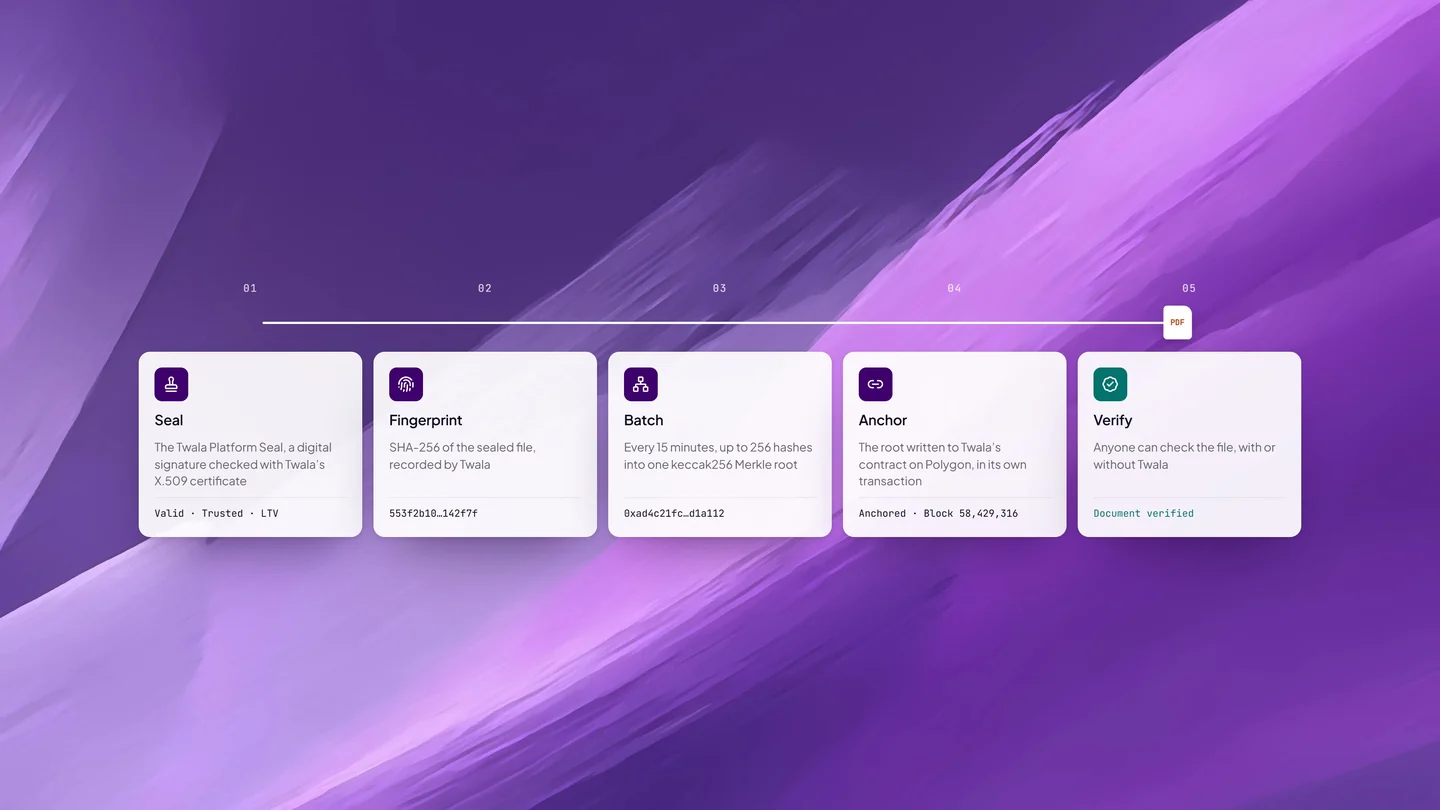
An eNotarized PDF on Twala carries the notary’s seal on a certificate page and a digital seal over the entire file, with a trusted timestamp inside the signature. Its fingerprint is then anchored on the Polygon blockchain through HashOrigin™ technology. Change a single word, and verification shows Document tampered.
The paperwork files itself
A notary’s register used to live in bound books on an office shelf. Under the new Rules, the notarized document is uploaded automatically to the Supreme Court’s Central Notarial Database. On Twala, each act is entered in the notary’s register as soon as it’s sealed and filed with the Supreme Court, and each month of the register becomes a notarial book. On your side, the notarized PDF waits under Notarizations in your account. Need another copy next year? Download it again instead of going back to the notary’s office.
When the traditional route still makes sense
eNotarization doesn’t cover everything. Go to a traditional notary when:
- the document is a notarial will or a deposition, both of which stay under the 2004 Rules;
- the receiving office insists on a paper original signed in ink; or
- the document was already signed by hand and has to be notarized in that form.
And if someone who must appear is abroad, neither route works from where they are. Our guide for OFWs and Filipinos abroad explains the options.
For everything else, the choice is practical. Where are the signers? What will the receiving office accept? How soon do you need it? Our list of documents you can eNotarize is a good place to check.
The job hasn’t changed
The notary still stands between a document and the people who will rely on it, checking who signed it and whether they meant to. What eNotarization removes is everything around that job: the trip across town, the queue, the courier, and the guesswork about whether a seal is real.
To see it from your side of the screen, read what happens during a remote notarization session, or start with our complete guide to eNotarization in the Philippines. When you’re ready, get notarized on Twala.
Twala is a Supreme Court-accredited Electronic Notarization Facility (ENF). Twala is a technology provider and does not give legal advice. Notarial acts are performed by commissioned Electronic Notaries Public.