Is Online Notarization Safe? How eNotarization Stops Fraud
Online notarization is safe when it follows the Supreme Court’s rules, and in several ways it is harder to fake than paper. Here is where paper notarization breaks down, and how eNotarization closes each gap.
The question is a fair one. Notarization exists because some documents matter too much to take on trust: a deed that moves a property, a special power of attorney that lets someone else act for you, an affidavit you swear to. Asking whether a video call and a PDF can carry that weight is the right instinct.
The better question, though, is safe compared to what. Paper notarization was never as secure as a dry seal makes it look.
Where paper notarization breaks down
A paper notarization rests on things that are easy to copy: an embossed seal, a signature, a commission number, a PTR number, and a handwritten line in a register book.
The Supreme Court has dealt with the consequences. In a case that grew out of the Malampaya Fund scandal, documents had allegedly been forged using the notarial seals and signatures of three lawyers. The Court ruled that lawyers cannot be held liable for the misuse of their seals without clear proof that they knowingly allowed it. In doing so, it recognized how easily third parties can create fake seals and stamps, noted the irregularities that pointed to forgery (missing commission serial numbers, office addresses, and PTR details), and called for stronger safeguards against fraudulent notarizations. We wrote about the ruling in what the SC’s ruling on fraudulent notarial seals shows.
The everyday problems are smaller but more common: people posing as notaries, documents notarized without the signer ever appearing, backdated acknowledgments, and documents notarized with blanks that get filled in later. Our older guide to avoiding notary scams lists the usual ones.
How eNotarization closes each gap
The Rules on Electronic Notarization (A.M. No. 24-10-14-SC) were written with these weaknesses in mind. Every accredited facility has to meet the same technical baseline: e-KYC consistent with Bangko Sentral rules, multi-factor authentication, liveness detection, geolocation that detects VPNs, tamper-evident security, a way to verify eNotarized documents, real-time backup of notarial books, and a link to the Supreme Court’s database. That floor is what makes eNotarization safe in general. Here is how each risk is handled on Twala.
| The risk | On paper | On Twala |
|---|---|---|
| Someone pretends to be the signer | An ID card, checked by eye across a desk | A National ID checked against the national registry, or a government-issued ID, plus a live face scan matched to it before anyone can book |
| The signer never actually appears | Depends entirely on the notary’s honesty | Everyone joins a live audio-video session, or appears in person; pre-recorded videos are prohibited, location is checked, and VPNs, proxies, and Tor are blocked |
| A fake notary or a forged seal | A rubber stamp and a signature that anyone can imitate | Only Electronic Notaries Public commissioned by the Supreme Court and approved on Twala; the seal is a digital signature, not a picture of one |
| Backdating | A date typed or written on the page | A trusted RFC 3161 timestamp in every signature, and the document’s fingerprint anchored on the Polygon blockchain in the next 15-minute batch |
| Blanks filled in or pages swapped later | Hard to detect once the original leaves the office | The document is final before the session; after sealing, any change shows as Document tampered |
| A lost or borrowed register | Bound books that can go missing | An Electronic Notarial Book backed up in real time, with each notarized document uploaded automatically to the Supreme Court’s Central Notarial Database |
Two rows deserve a closer look.
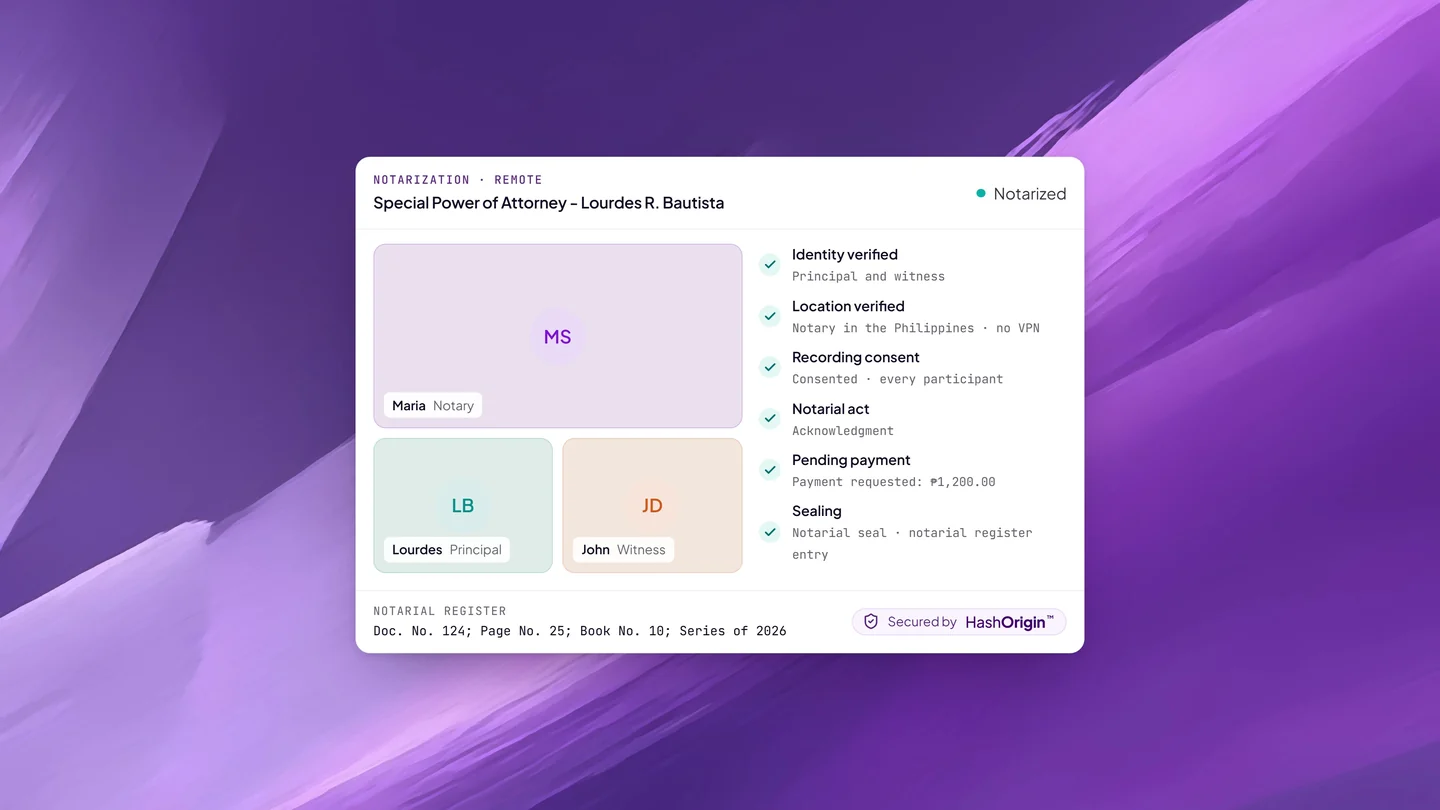
The first is identity. On paper, the notary compares your face with a small photo on a card, sometimes in a crowded office. On Twala, the check happens before the appointment exists: the National ID route pulls your details from the registry itself, and the face scan has to match. Then the Electronic Notary Public (ENP) still sees and hears you live in the session. Our explainer on identity verification in online notarization covers each step.
The second is the seal. A paper seal proves very little once someone has copied it. A digital seal works the other way around: it is bound to the exact file it was applied to. Change a single word and the signature no longer matches, so the document fails verification. That is why anyone receiving an eNotarized document can verify it themselves in a few minutes, without calling the notary.
The safeguards protect notaries, too
In the Malampaya-related case, the lawyers’ defense rested on what the forgers had gotten wrong. A notary shouldn’t have to depend on that.
With eNotarization on Twala, a notarial act can only be performed from the ENP’s own account, which supports two-factor authentication and allows one sign-in at a time. Every genuine act leaves an entry in the ENP’s notarial register, filed with the Supreme Court, and an activity log on the notarization. A document that claims to be notarized but has no such record, and no valid digital seal, is easy to disown.
What you should still do
The platform handles most of the work, but a few habits are still yours:
- Use an accredited facility. eNotarization happens only through an Electronic Notarization Facility accredited by the Supreme Court. The pandemic-era interim rules that let paper documents be notarized over video calls have been repealed, so an “online notary” on social media who asks you to send a PDF and pay is not offering eNotarization. See how to spot a fake online notary.
- Keep your account to yourself. Turn on two-factor authentication, and never share a one-time code, even with someone who says they are from Twala.
- Read before you sign. Notarization confirms who signed and that they signed freely. It doesn’t make a bad agreement good. If a clause is unclear, ask before the session, not during it.
- Share the PDF, not a printout. The protections live in the file.
- Verify what you receive. If someone sends you an eNotarized document, check it.
Frequently asked questions
Is a remote notarization as valid as one done in person?
Yes. Under the Rules on Electronic Notarization, an electronic notarial act performed through an accredited facility has the same validity, force, and effect as a traditional one, whether it was done remotely or in person.
Can my session be recorded without my knowledge?
No. A session is recorded only if the notary asks and only once everyone in it consents. If anyone declines, nothing is recorded and the session goes on. Only the notary can open a recording.
Is my personal data safe?
Twala handles personal data under the Data Privacy Act of 2012, and nothing is collected for identity verification until you consent. Every connection uses HTTPS, and sensitive fields such as bank details are encrypted by the application before they are stored. Our overview of Twala’s security goes layer by layer.
If you’re ready to try it, our step-by-step guide to notarizing online takes you from a new account to a notarized PDF, and the eNotary overview shows the safeguards in the product. For everything else, see our complete guide to eNotarization in the Philippines.
Twala is a Supreme Court-accredited Electronic Notarization Facility (ENF). Twala is a technology provider and does not give legal advice. Notarial acts are performed by commissioned Electronic Notaries Public.