How to Choose an eNotarization Platform in the Philippines: 12 Questions

Every eNotarization platform in the Philippines must be accredited by the Supreme Court, but accreditation only starts the comparison. These 12 questions show which platform fits you, your law office, or your company.
On August 5, 2026, the Court accredited its first batch of Electronic Notarization Facility (ENF) providers under the 2025 Rules on Electronic Notarization (A.M. No. 24-10-14-SC): Ohelio Inc.’s Twala, Quanby Solutions Inc.’s QLegal, and UNAWA Inc.’s NotarizeIT. For the current list, check the Supreme Court’s eNotarization page.
Accreditation already guarantees a good deal. Under the Rules, every accredited ENF must meet the same technical baseline: identity checks consistent with Bangko Sentral ng Pilipinas e-KYC rules, multi-factor authentication, liveness detection, geolocation that detects VPNs, tamper-evident security, a way to verify eNotarized documents, real-time backup of notarial books, registration with the National Privacy Commission, a link to the Supreme Court’s database, and 99.9% uptime. A notarial act performed by a commissioned Electronic Notary Public (ENP) through any accredited facility has the same validity, force, and effect as a traditional one.
So the useful questions are about what a platform does above that floor: how deep its identity checks go, whether anyone can verify a document without asking the platform, what you can do before and after the session, and whether it can carry a whole company’s paperwork as easily as one affidavit.
The choice is also bigger than it looks. Everyone who appears before the notary, signers and witnesses alike, needs an account and a verified identity on the platform the notary uses. An ENP may work on more than one accredited ENF, keeping a separate account, notarial book, and seal on each, so ask your notary which platform your document will go through. Whichever you settle on is the one your co-signers, witnesses, employees, and clients will be asked to join.
We have put Twala’s answer under each question. Put the same questions to any provider you are considering.
Trust and track record
1. Is it accredited by the Supreme Court?
This is the floor. An electronic notarization is valid only when it runs through an accredited ENF, which rules out pages offering to “notarize” a PDF over chat or email. An ordinary video call isn’t eNotarization either: the Rules repealed the 2020 interim rules on remote notarization of paper documents. Find the provider’s accreditation, find the company behind it, and match the name against the Court’s list.
Twala: accredited on August 5, 2026, in the first batch of three. Twala is the platform of Ohelio Inc., based in Taguig City. The Philippines’ first two eNotarized documents, agreements with the Integrated Bar of the Philippines (IBP) and the University of the Philippines College of Law, were notarized on Twala at the official launch on October 19, 2026.
2. What has it done before eNotarization?
Electronic notarization only went live in October 2026. A provider’s years of work on electronic signatures, identity checks, and document security say more about it than a launch announcement does.
Twala: founded in 2020 as TwalaSign, a digital signature platform, and working with the Supreme Court on electronic notarization since July 2020. Twala serves more than 600 companies and more than 1.3 million individual users. Its customers, by Twala’s count, close agreements 80% faster and spend 40% less time and material on each.
3. Who stands behind it?
Grants, awards from regulators, and memberships in standards bodies are worth asking about, because each one means someone outside the company examined the work.
Twala: a DOST-backed startup that received a ₱4.6 million grant from DOST-PCIEERD’s Startup Grant Fund Program in 2022 and keeps an R&D partnership with DOST-ASTI. The Anti-Red Tape Authority named Twala an Ease of Doing Business Champion for 2024, the only non-government awardee among 21. Twala is the only Philippine member of the Cloud Signature Consortium, the global standards body for cloud-based digital signatures, and in January 2026 it signed a national partnership with the IBP. The full list is in the institutions behind Twala.
Identity and proof
4. What is your ID checked against?
Every ENF has to confirm identity with a valid government-issued ID and catch fakes with liveness detection. Ask what the ID is actually compared with. A photo of a card proves less than a check against the record that issued it.
Twala: a Philippine National ID is checked against the national registry when you scan the QR code on the card. A photo of another government-issued ID that hasn’t expired is also accepted. Either way, a face scan is matched to the ID photo, and the notary cannot perform the act until every principal and witness is verified. Location is checked when you book and when you join, with VPNs, proxies, and Tor blocked, and two-factor authentication protects sign-in. Our explainer on identity verification in online notarization has the details.
5. Can anyone verify a notarized document without asking the platform?
A notarized document travels to banks, HR departments, landlords, and government offices. Each of them needs a way to confirm it is genuine and unchanged, preferably one that doesn’t depend on the platform vouching for itself.
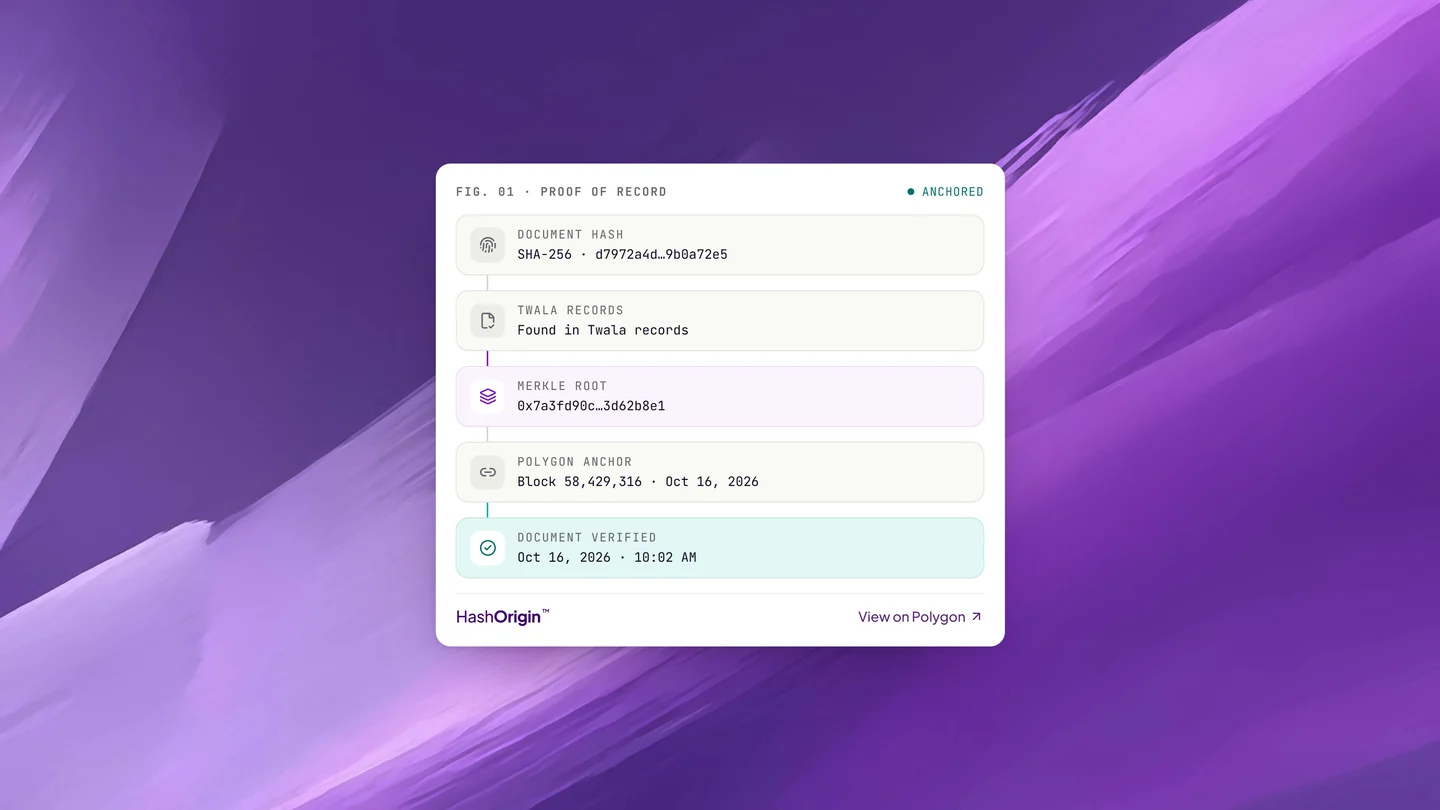
Twala: every notarized PDF is converted to PDF/A-2b and sealed with the Twala Platform Seal, a digital signature made with Twala’s X.509 certificate that carries an RFC 3161 timestamp. The sealed file’s fingerprint is then anchored on the Polygon blockchain, a public network, through HashOrigin™ technology, so a third party can confirm the record without relying on Twala as a single point of trust. Twala’s verify page is the quickest check, and any change after notarization shows up there as Document tampered. A PDF reader that checks digital signatures, such as Adobe Acrobat, can also confirm the file is unchanged since sealing, though it may not recognize the signer unless it trusts Twala’s certificate. See how to verify an eNotarized document.
Before and after the notarization
6. Can you prepare and sign the document on the same platform?
Most documents are drafted, negotiated, and signed long before they reach a notary. A platform that only covers the notarial act sends you back to email attachments for everything that comes first.
Twala: start from a template and have AI draft from your own files, review and mark up the draft, then collect eSignatures in an envelope, in the order you set, with automatic reminders. Signing is always free for signers. When the document is ready, request the notarization from the same screen. We follow one contract through every stage in from draft to notarized.
7. What happens to the document afterward?
A notarized contract still has a life ahead of it: renewals, audits, disputes, and the day someone needs to find it in a hurry.
Twala: once the fee is paid, Twala adds the notarial certificate page and the notary’s seal with a QR code, enters the act in the notary’s notarial register, and files it with the Supreme Court, and you can download the PDF from Notarizations whenever you need it. Saved to a workspace, the document keeps its versions, turns up in one search alongside envelopes and templates, and can be put on a task board with a renewal date. Data extraction pulls its key terms into CSV or JSON.
8. Is there AI, and is it private?
AI can save hours of drafting and review, but legal documents are confidential. Ask where the AI runs and whether your files are used to train it.
Twala: Lex, the AI inside Twala, drafts and revises documents, answers questions from your files and names the files it used, and searches a Philippine Laws and Jurisprudence library when your files leave a gap. Lex runs privately under Twala’s own cloud account, AI search is opt-in for each file, and no user data is ever used to train the AI. Meet Lex for the full picture.
Running it at scale
9. Can it run across a whole company?
A company that notarizes every week needs controls as well as a login: roles, access, audit trails, and a link to the sign-in and security tools it already runs.
Twala: team workspaces have Owner, Admin, and Member roles, and owners and admins decide who may use notary and AI features. Access is checked on every request, and the audit log carries HMAC-SHA256 integrity checks. The Business plans add team management, custom branding, and a Business verified digital seal. Enterprise adds single sign-on through SAML or OpenID Connect, SIEM integration, advanced logging, a PKI digital seal, and a guaranteed SLA. More in eNotarization for businesses.
10. How does it handle your personal data?
An eNotarization involves IDs, face scans, and home addresses. Ask who can see them and under what rules.
Twala: nothing is collected for identity verification until you consent. Twala complies with the Data Privacy Act of 2012 (R.A. 10173), keeps a Privacy Manual, and has a designated Data Protection Officer. Only the notary and the principals can open a notarized document; witnesses see its status and register details, never the document itself. Twala is also working toward certification under ISO/IEC 27001, the international standard for information security management, with an internal management system for it already in place. Read more in inside Twala’s security.
Cost and availability
11. Does it publish its prices?
A price list you can read before signing up is a good sign. So is a clear line between what you pay and what your notary pays.
Twala: plans are on the pricing page, from the free Personal plan to Professional at ₱990, Business at ₱1,690, and Business Plus at ₱2,390 per seat a month, VAT inclusive, with custom Enterprise pricing. Notary credit packages for ENPs are published too, from ₱500 for 5 credits to ₱5,000 for 76, plus VAT. If you are the one being notarized, requesting is free, and you pay the notarial fee your ENP sets, within any guide on notarial fees the Supreme Court issues, plus 12% VAT and documentary stamp tax when you pay online. Identity verification has its own fee, shown before you start, and stays valid until your ID expires or for three years. The full breakdown is in how much online notarization costs.
12. When can you use it?
Notarization rarely waits for a convenient hour. A lost ID on a Friday night or a contract that has to close before Monday shouldn’t mean waiting for an office to open.
Twala: open 24/7. You can create an account, verify your ID, sign, request a notarization, message your notary, pay, download, and verify documents at any hour. Sessions run in your ENP’s open times. ENPs set their own hours and can work from anywhere in the Philippines, so choose one whose schedule suits yours. More in online notarization 24/7.
The 12 questions at a glance
| Question | A good answer | Twala |
|---|---|---|
| Accreditation | Named on the Supreme Court’s list | Accredited August 5, 2026 |
| Track record | Years of signing and identity work | Since 2020; 1.3 million users; 600+ companies |
| Backing | Outside institutions that reviewed the work | DOST-PCIEERD grant; ARTA champion for 2024; Cloud Signature Consortium member |
| Identity | The ID checked against its issuing record | National ID checked against the national registry; face scan |
| Verification | Anyone can check, independently | PKI seal, RFC 3161 timestamp, Polygon anchor, verify page |
| Before the act | Draft and sign in the same place | AI drafting, review, eSignature envelopes |
| After the act | Stored, searchable, tracked | Workspaces, search, task boards, data extraction |
| AI | Useful and private | Lex; no training on user data; opt-in per file |
| Company use | Roles, single sign-on, audit | Roles, SAML and OpenID Connect, audit log, SIEM on Enterprise |
| Privacy | Consent and limited access | Data Privacy Act compliance; Data Protection Officer; consent first |
| Prices | Published before you sign up | Plans and ENP credit packages on the pricing page |
| Hours | Usable after office hours | Open 24/7; sessions in your ENP’s open times |
Where to go from here
If you need a document notarized, Get notarized walks you through it, and our complete guide to eNotarization in the Philippines covers the rules. Lawyers can apply as an Electronic Notary Public on Twala, and companies can talk to our team about a rollout.
Twala is a Supreme Court-accredited Electronic Notarization Facility (ENF). Twala is a technology provider and does not give legal advice. Notarial acts are performed by commissioned Electronic Notaries Public.