Extrajudicial Settlement of Estate: Notarizing It Online When Heirs Live Apart

An extrajudicial settlement of estate can now be notarized online in the Philippines, with every heir appearing before the notary in one remote session from wherever they live in the country.
When their mother passed away, the Villanueva siblings inherited a house and lot in Iloilo City. One sibling lives in Davao, another in Quezon City, and the youngest stayed in Iloilo. Getting all three in front of one notary used to mean plane tickets, a long weekend, or months of waiting for the next family occasion. With electronic notarization, they can sign the same deed on Twala and appear together in one video session, each from home.
The notarization is the easy part, though. An estate has other steps, and this guide covers both.
What an extrajudicial settlement is
When someone dies without a will, Rule 74 of the Rules of Court lets the heirs divide the estate among themselves without going to court. They do it in a public instrument, the deed of extrajudicial settlement, which is filed with the Registry of Deeds. When there is only one heir, the equivalent document is an affidavit of self-adjudication.
Before anyone signs, three conditions have to hold:
- There is no will. If there is one, it goes through probate in court.
- The estate has no outstanding debts.
- The heirs are all of age, or the minors among them are represented by their judicial or legal representatives. A minor’s share is one place where a lawyer’s advice is worth paying for.
The heirs also have to agree on the division. If they can’t, the remedy under Rule 74 is an ordinary court action for partition, not a settlement.
Why notarization is part of it
Rule 74 calls for a public instrument, and a private document becomes a public one when it is notarized. For an extrajudicial settlement, then, notarization is a requirement rather than a formality. It also gives the deed the weight of a public document: admissible in court without further proof that it is genuine, and presumed regular unless clear and convincing evidence shows otherwise. We explain that weight in why a notarized document carries weight.
One session for heirs in different provinces
Under the Supreme Court’s Rules on Electronic Notarization (A.M. No. 24-10-14-SC), an Electronic Notary Public (ENP) can notarize for parties anywhere in the Philippines, and appearing by videoconference counts as appearing in person. A deed of extrajudicial settlement is notarized by acknowledgment, so each heir can sign it on Twala before the session and confirm that signature to the ENP. On Twala, it goes like this:
- Each heir creates a free Twala account and verifies their identity once, with a Philippine National ID or another government-issued ID that hasn’t expired, followed by a face scan.
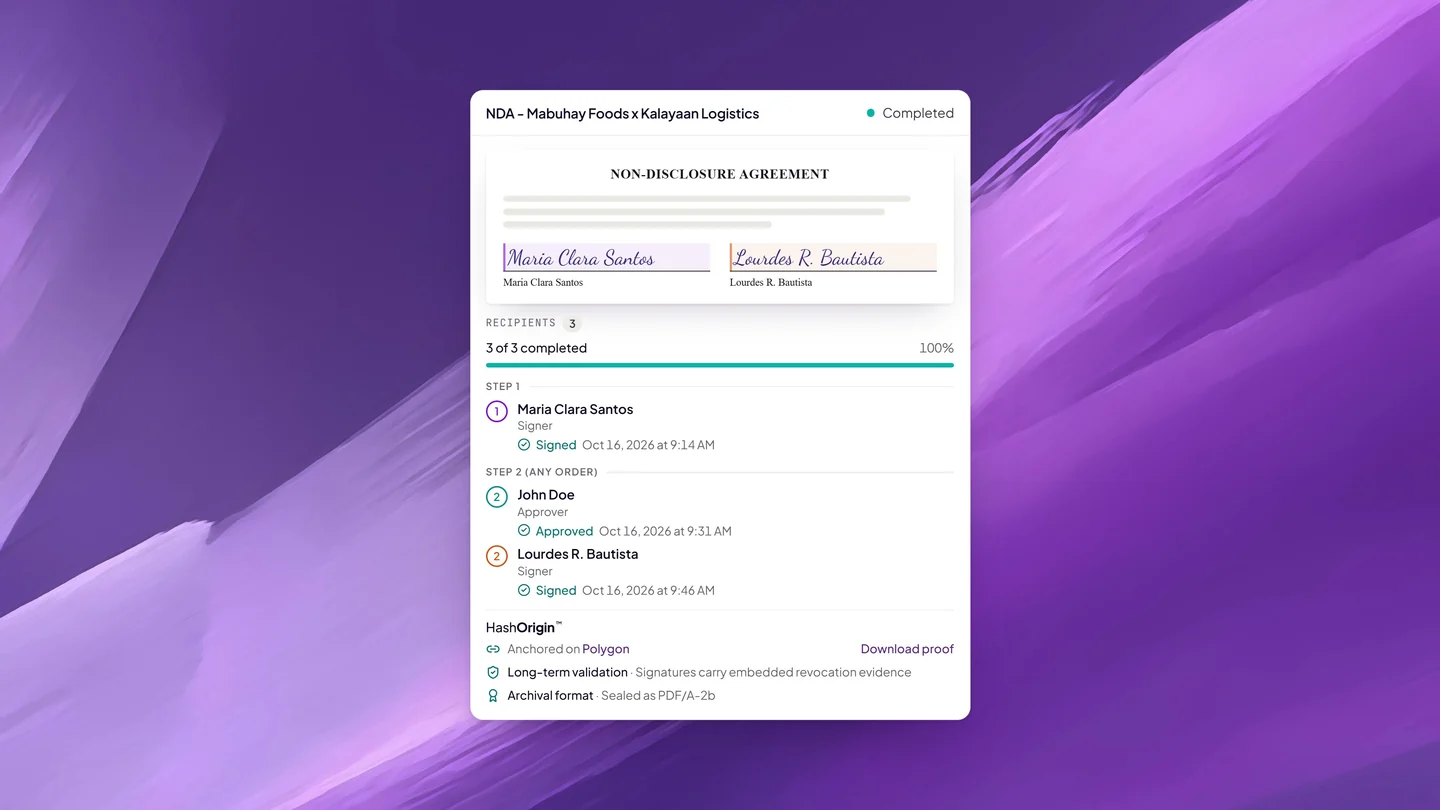
- One heir uploads the final deed and sends it through an envelope to every heir who signs it, plus any witnesses. The envelope tracks who has signed and reminds the rest.
- That heir requests a notarization appointment, adds the signed deed, chooses Remote, picks an ENP and one of their open times, and adds the other heirs as principals and any witnesses as witnesses.
- At the session, everyone clicks Join session from wherever they are in the Philippines, with VPNs off. The ENP confirms each person’s identity and that they understand the deed, and each heir acknowledges it.
- Once the fee is paid, Twala adds the notarial certificate page and seal, enters the act in the notary’s notarial register, and files it with the Supreme Court. Every heir who appeared as a principal can download the notarized PDF.
Everyone has to be in the Philippines at the time of the session, and Twala checks each person’s location as they join. An heir working abroad can’t appear in a Twala session from overseas. A common route is for that heir to sign a special power of attorney abroad so that a representative in the Philippines can act for them, preferably with a lawyer’s help on the wording. Our guides to the special power of attorney and to eNotarization for OFWs and Filipinos abroad explain the options.
What still comes after the notarization
Settling an estate takes more than a notarized deed, and none of the remaining steps happen on their own once the deed is sealed:
- Publication. The settlement has to be published in a newspaper of general circulation once a week for three consecutive weeks.
- Bond. When personal property is part of the estate, Rule 74 requires a bond filed with the Registry of Deeds, in an amount equal to the value of that property.
- Estate tax. The heirs file the estate tax return and pay the tax with the BIR, which issues the certificate the Registry of Deeds needs before it transfers a title.
- Transfer and registration. The local transfer tax with the city or provincial treasurer, then registration with the Registry of Deeds where the property is, then a new tax declaration from the assessor.
Rule 74 also protects anyone who was left out. A settlement doesn’t bind a person who didn’t take part in it or had no notice of it, which is one more reason to involve every heir from the start.
Registering an electronically notarized deed
For years, the open question was whether the Registers of Deeds would accept an electronically notarized instrument at all. On October 13, 2026, the Supreme Court and the Land Registration Authority signed a joint memorandum circular on the use of electronically notarized documents in transactions with the LRA and the Registers of Deeds (SC-LRA JMC No. 1, s. 2026). Associate Justice Alfredo Benjamin Caguioa said the circulars signed that day “categorically clarify the acceptability of eNotarized documents.” The Supreme Court’s announcement has the details of the signing.
The LRA had been preparing for eNotarization and had raised the question of accepting electronic documents with the Supreme Court. Still, check the specific requirements of the Registry of Deeds where the property is located, and ask the BIR what form of the deed it needs for the estate tax, before you file anything. For the wider picture on property, see eNotarization in real estate.
Before the session: a short checklist
- The deed is final and complete, with no blanks, and every heir has read that version
- Each property is described the way its title or tax declaration describes it
- Every heir’s name matches the ID they verified with on Twala
- Any heir acting through a representative has the representative’s authority in hand
- Copies of the death certificate, titles, and tax declarations are within reach, since the later steps need them
When the family is ready, each heir can create a free Twala account and verify their identity, and Get notarized explains every screen. For the rules behind remote sessions, start with our complete guide to eNotarization in the Philippines.
Twala is a Supreme Court-accredited Electronic Notarization Facility (ENF). Twala is a technology provider and does not give legal advice. Notarial acts are performed by commissioned Electronic Notaries Public.