eNotarization in Real Estate: What Works Today and What to Check First

eNotarization already covers much of a Philippine real estate transaction, from leases and SPAs to deeds of sale. Here is what works today, and what to check with the Registry of Deeds first.
At the 5th General Membership Meeting of the Chamber of Real Estate and Builders’ Associations (CREBA) on August 27, 2026, Twala’s Director for Government Relations, Jiggy Calucag, walked members through a transaction everyone in the room knew by heart. A deed of sale is printed, signed by hand, notarized in person, couriered or hand-carried between the parties, and filed with the Registry of Deeds. A deal agreed in principle can take days or weeks to close.
The picture has changed since. On October 13, 2026, the Supreme Court signed guidelines with the Land Registration Authority (LRA) on using electronically notarized documents in transactions with the LRA and the Registers of Deeds. A commissioned Electronic Notary Public (ENP) can now notarize a deed, a lease, or a power of attorney for parties anywhere in the Philippines, through an accredited Electronic Notarization Facility (ENF) such as Twala, one of the first three the Court accredited.
What you can notarize online today
On Twala, an ENP can notarize most of the documents a property transaction produces:
- Lease or rental agreements, for houses, condominium units, offices, and warehouses
- Deeds of sale, donation, or assignment, and other sale or transfer agreements
- Contracts to sell and memorandums of agreement, such as those between developers and brokers
- Special powers of attorney, for an owner who authorizes a relative or a broker to act for them
- Mortgage and loan agreements
- Affidavits, and extrajudicial settlements of estate when heirs inherit property
Deeds, leases, and SPAs are usually notarized by acknowledgment, so the parties can sign through an envelope on Twala before the session and then confirm their signatures to the ENP. Affidavits are sworn to in a jurat, and the Rules have the affiant sign as part of the act; the ENP will tell you when on the appointment’s Messages tab.
Distance matters less than it used to. An ENP’s authority now covers the whole country, so a seller in Baguio, a buyer in Cebu, and an ENP in Manila can all appear in one remote session. Everyone in the session, the notary included, has to be in the Philippines. The Rules allow one exception, a principal appearing from inside a Philippine embassy or consulate, but Twala sessions require everyone to be in the country, so an OFW seller has other routes for now. Our guide for OFWs and Filipinos abroad sets them out.
Registration: from open questions to new guidelines
A sale of land isn’t finished when the deed is notarized. The taxes are paid, the Bureau of Internal Revenue clears the transfer, and the Registry of Deeds cancels the old title and issues a new one in the buyer’s name. Each office along the way sets its own requirements.
The LRA has been candid about what electronic documents would need. At an industry forum on eNotarization where Twala presented the new rules, LRA Administrator Atty. Gerardo P. Sirios listed four challenges to work through before electronic notarization and digital titling could run end to end:
- No clear policy yet on accepting paper versus electronic documents
- Allied agencies, including the DENR, DAR, NCIP, local government units, and the BIR, synchronizing their own systems
- Registration software developed in the early 2010s
- Public acceptance of digital titles, especially in rural areas where people place great value on the physical title
“We are really very excited. We have sent our position paper to the Supreme Court to address these issues,” Sirios said at the time. The LRA safeguards more than 20 million land titles through more than 180 Registries of Deeds, most of them already online, and it is working toward purely digital titles while keeping paper titles available to anyone who wants one. Our full account of the LRA’s plans has the rest.
Since then, the policy question has moved. On October 13, 2026, the Supreme Court and the LRA signed a joint memorandum circular, SC-LRA JMC No. 1, s. 2026: the “Guidelines for the Use of Electronically Notarized Documents in Transactions with the Land Registration Authority and Registers of Deeds.” At the signing, Associate Justice Alfredo Benjamin Caguioa said the circulars “categorically clarify the acceptability of eNotarized documents.”
The practical rule follows from that. Before you rely on an eNotarized deed or mortgage for registration, ask the Registry of Deeds handling the property what the guidelines require of your filing. A transfer also passes through the BIR and the local government, so ask each of those offices what it needs as well.
Leasing is the easiest place to start
A lease mostly lives between landlord and tenant, which makes it the simplest real estate document to move online first. A landlord in Quezon City and a tenant moving to Cebu can sign the lease on Twala, each on their own device, and appear before an ENP in one remote session. If the lease names witnesses, they sign on Twala too and appear with everyone else. Our step-by-step guide to notarizing a lease agreement online covers the session itself.
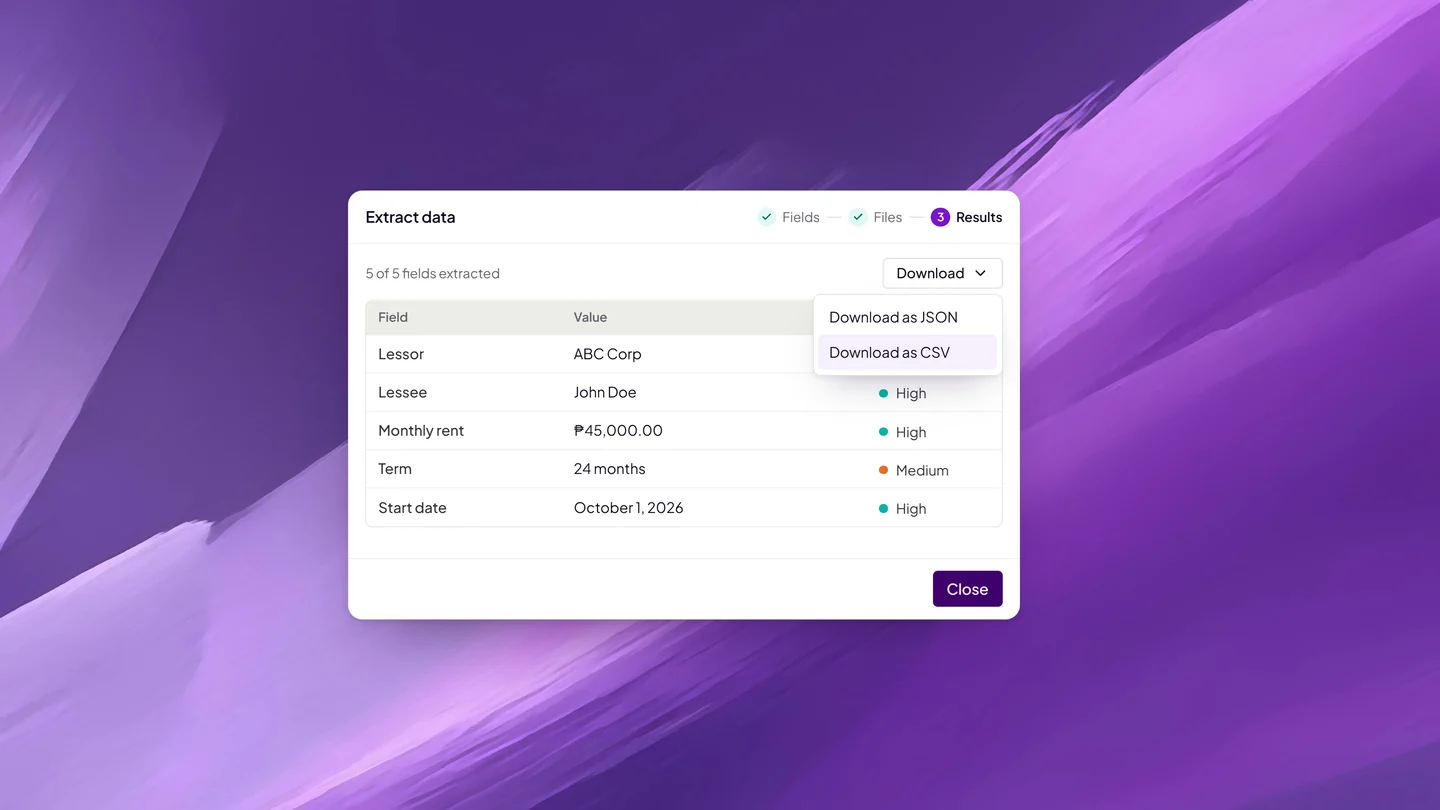
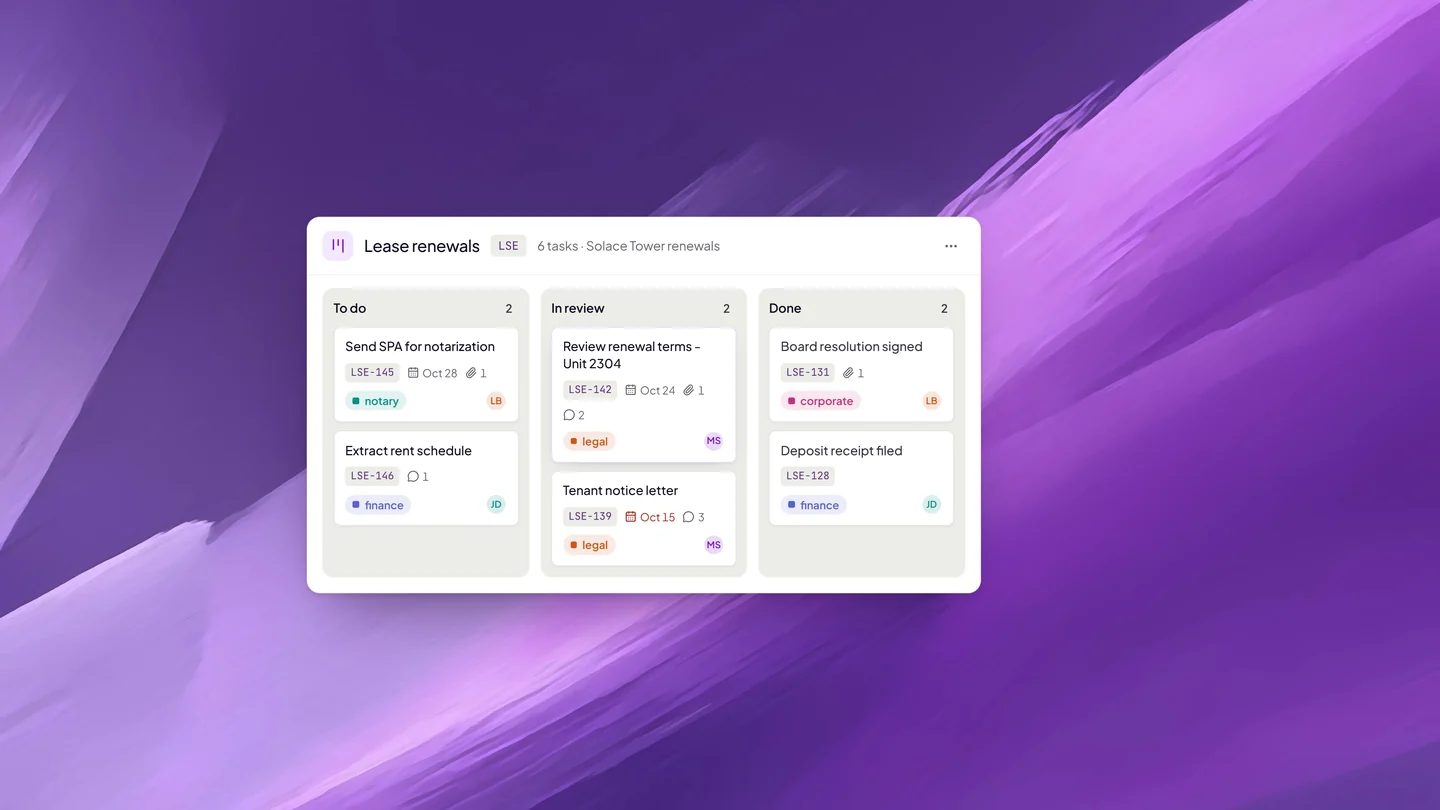
For property managers with dozens or hundreds of units, the rest of Twala handles the follow-through. Data extraction reads each lease and returns the lessor, lessee, monthly rent, term, and start date in a table, with a confidence level on every value, ready to download as CSV or JSON. Task boards track renewals, tenant notices, and deposits, with an assignee and a due date on each task.
For developers and brokers
Developers work in volume: contracts to sell, deeds of absolute sale at turnover, SPAs from buyers who can’t attend, and agreements with brokers. On Twala, each project can have its own team workspace, with roles that decide who drafts, who sends for signing, and who can request notarizations. Envelopes carry several documents and signers in the order you set, and reusable templates keep the fields and roles in place for the next buyer. Each buyer still appears before the ENP for their own documents. What the platform removes is the printing, the couriers, and the trips.
Developers and brokers also receive documents, and that’s where fraud tends to enter. Forged SPAs and fake deeds are an old story in Philippine property disputes. An eNotarized PDF can be checked on Twala’s verify page, where any change made after notarization shows as Document tampered, and the act itself is entered in the notary’s register and filed with the Supreme Court. Build that check into every closing. How to verify an eNotarized document shows how.
A home for every Filipino, with less paper
CREBA’s theme for the meeting where Twala spoke was “A Home for Every Filipino.” Calucag’s point to the members was that the mission covers more than building houses. It also means making it simpler, safer, and faster for Filipinos to buy and sell them.
The parts of a property deal that happen between people (agreeing, signing, and appearing before a notary) can now happen online anywhere in the country. The parts that happen inside government offices are catching up, starting with the LRA and the Registers of Deeds. As Atty. Third Bagro wrote in The Last Mile of Digitalization: “The last mile is here. Now the rest of the country must walk it.”
Related reading: getting an SPA notarized online, extrajudicial settlement when heirs live apart, and eNotarization for banks and lenders. The complete guide to eNotarization in the Philippines covers the rules, and developers, brokerages, and property managers can talk to our team about a team plan.
Twala is a Supreme Court-accredited Electronic Notarization Facility (ENF). Twala is a technology provider and does not give legal advice. Notarial acts are performed by commissioned Electronic Notaries Public.