eNotarization for Banks, Lending Companies, and Cooperatives

eNotarization lets banks, lending companies, and cooperatives in the Philippines notarize loan agreements, mortgages, and powers of attorney online, with each borrower’s identity verified before the session.
Lending went digital at the front some time ago. Applications come in through a phone, credit decisions come out of a system, and proceeds land in an account. The back end is another story. A borrower in a Bicol town may still ride to the branch to sign, then to a notary near the municipal hall, so a loan approved on a Tuesday closes the following week. Atty. Third Bagro made the same point in The Last Mile of Digitalization: a loan application can be online while the mortgage still needs a wet signature.
The Supreme Court’s Rules on Electronic Notarization (A.M. No. 24-10-14-SC) close much of that gap. Under them, a commissioned Electronic Notary Public (ENP) can notarize an electronic document for borrowers anywhere in the Philippines through an accredited Electronic Notarization Facility (ENF). Twala is one of the first three ENFs the Court accredited.
What lenders can notarize online
Most of a lender’s notarized paperwork falls under document types an ENP can notarize on Twala:
- Loan or credit agreements, from salary loans to member loans
- Mortgage agreements
- Special and general powers of attorney, for borrowers who authorize someone to transact for them
- Authorization letters
- Affidavits, including affidavits of loss
- Deeds of sale or assignment, and other sale or transfer agreements
Loan and mortgage documents are usually notarized by acknowledgment, so the borrower, the co-makers, and the lender’s signatory can sign through an envelope before the session and then confirm their signatures to the ENP. An affidavit is different. It’s sworn to in a jurat, and the Rules have the affiant sign as part of the act, so the ENP will say when.
Notarization and registration are also separate steps. A real estate mortgage has to be recorded with the Registry of Deeds to bind third parties. On October 13, 2026, the Supreme Court and the Land Registration Authority signed a joint memorandum circular, SC-LRA JMC No. 1, s. 2026, which sets guidelines for using electronically notarized documents in transactions with the LRA and the Registers of Deeds (Supreme Court announcement). Before you file an eNotarized mortgage, check the specific requirements of the Registry handling the property. Our piece on eNotarization in real estate covers how registration is developing.
Know your borrower
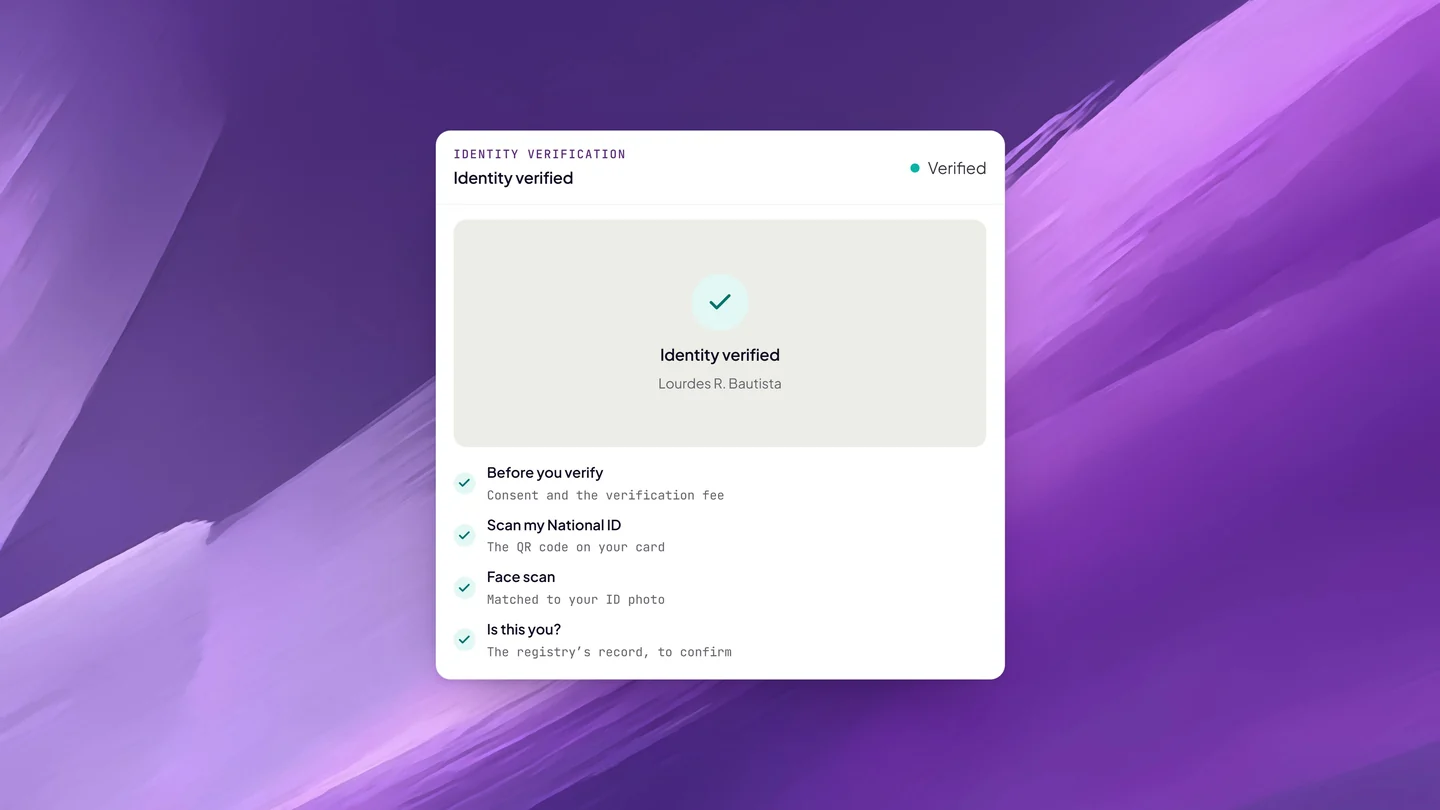
A notarization rests on one question: is the person in front of the notary who they say they are? The Rules require every accredited ENF to answer it with e-KYC consistent with Bangko Sentral ng Pilipinas rules, multi-factor authentication, and liveness detection, and to turn away anyone whose ID is expired or invalid.
On Twala, a borrower verifies once. With a Philippine National ID, they scan the QR code on the card, and Twala checks it against the national registry; otherwise, they photograph a government-issued ID that hasn’t expired. A face scan is then matched to the ID photo. The verification stays current until the ID expires or for three years, whichever comes first, and Twala’s identity checks are aligned with the BSP’s e-KYC and authentication guidelines and with NIST SP 800-63-3. In the session, Twala checks every participant’s location and blocks VPNs, proxies, and Tor, while the ENP confirms the borrower’s identity and that they are signing freely.
None of this replaces a lender’s own customer due diligence. What it adds is something paper never offered: a verified, live appearance before a notary, tied to a document that shows any later change. How identity verification works in online notarization covers the details.
Branches, field officers, and members in the provinces
An ENP’s authority is no longer tied to the city where they were commissioned. A cooperative in Davao can work with an ENP in Cebu, and a member in a far barangay can appear from a phone instead of traveling to the branch, as long as everyone is in the Philippines and the connection holds at 2 Mbps or better.
Some lenders will still want the borrower at the counter. In-person electronic notarization keeps the physical appearance: the borrower, the bank officer, and the ENP meet, and the document is signed and notarized electronically. The branch keeps its face-to-face signing and ends up with a sealed, verifiable PDF instead of a folder of paper.
Cooperatives started moving their paperwork online before eNotarization was possible. In August 2023, the National Confederation of Cooperatives (NATCCO) signed a two-year contract with Twala to digitalize the cooperative sector.
A record that holds up years later
For a lender, a notarized document earns its keep long after the signing: in an audit, a collection case, or a foreclosure. The record has to last.
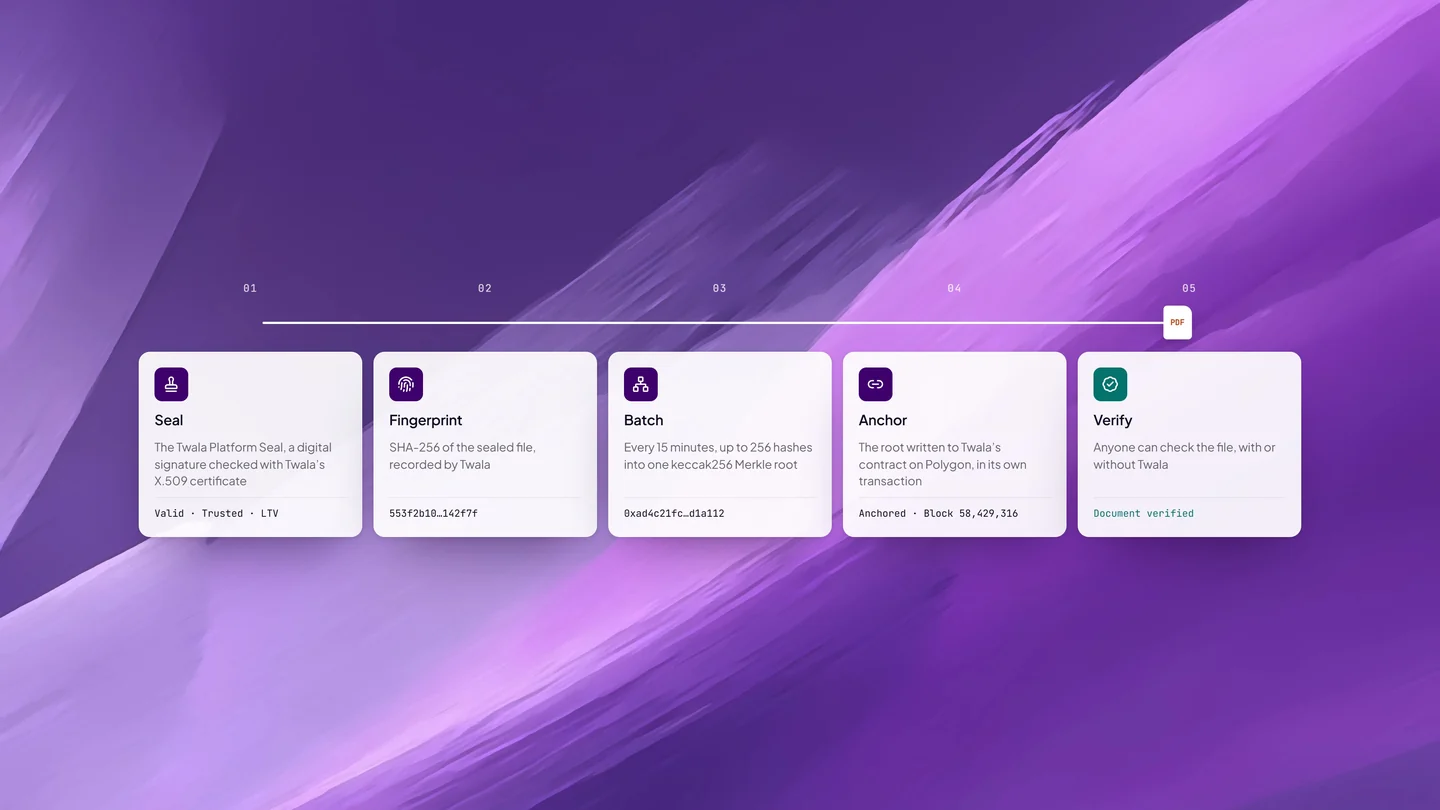
When the notarial fee is paid, Twala adds the notarial certificate page and the ENP’s seal with a QR code, enters the act in the notary’s notarial register, and files it with the Supreme Court. The PDF is converted to the archival PDF/A-2b format and sealed with the Twala Platform Seal, a digital signature made with Twala’s X.509 certificate, with an RFC 3161 timestamp inside. The sealed file’s SHA-256 fingerprint is anchored on the Polygon blockchain with HashOrigin™, in batches every 15 minutes, and long-term validation keeps the signatures checkable after their certificates expire, when every signature carries it.
So anyone holding a copy, whether your auditor, the borrower’s lawyer, or a court, can verify it without relying on Twala as a single point of trust. Any change made after notarization shows as Document tampered on Twala’s verify page. HashOrigin explained walks through how the anchoring works.
Fitting it into loan operations
eNotarization is one step in a longer workflow, and Twala covers the rest of it in the same place:
- Draft loan documents from the finance and legal templates, and let Lex propose edits that go in only when someone clicks Apply.
- Sign with envelopes that put the borrower, the co-makers, and the lender’s officer in order, with automatic reminders and a timeline of who opened, signed, or declined.
- Extract the terms you track, such as the principal, rate, term, and maturity date, into CSV or JSON, with a confidence level on each value.
- Control access with team roles, and decide member by member who can use notary features.
- Report on envelopes and files, exported as CSV or PDF.
For institutions whose security teams need more, the Enterprise plan adds single sign-on through SAML or OpenID Connect, advanced logging, SIEM integration, a PKI digital seal, a guaranteed SLA, and premium support. Lex, the AI inside Twala, runs privately under Twala’s own cloud account, and no user data is ever used to train it. Inside Twala’s security goes through each layer, and the security page lists the controls.
What doesn’t change
eNotarization moves the appearance online. It leaves the substance of lending alone. The credit decision is still yours, and so are your disclosures to the borrower and the registration of your security with the proper registry. The borrower still has to appear before the notary live, whether in person or over video. And each act still costs what notarization costs: the notarial fee the ENP sets, 12% VAT, and documentary stamp tax.
What changes is the distance between approved and signed.
Banks, lending companies, and cooperatives that want to try it on one loan product can talk to our team. For the wider picture, read eNotarization for businesses and the complete guide to eNotarization in the Philippines.
Twala is a Supreme Court-accredited Electronic Notarization Facility (ENF). Twala is a technology provider and does not give legal advice. Notarial acts are performed by commissioned Electronic Notaries Public.