How to Notarize an Affidavit of Loss Online

You can notarize an affidavit of loss online in the Philippines: prepare it as a PDF, book an Electronic Notary Public on Twala, then sign it and swear to it over live video.
Losses rarely happen at a convenient time. A wallet slips out of a pocket on a jeepney, a bag is snatched outside a mall, a passbook goes missing in a move. The bank, school, or government office that replaces what you lost will usually ask for the same thing first: an affidavit of loss. Until this year, that meant finding a notary’s office during office hours. With electronic notarization, you can now do it from home.
What an affidavit of loss is
An affidavit of loss is a sworn statement, in your own name, of what you lost and how. It tells the office that will replace the item what went missing, when and where, and that you couldn’t find it despite looking. Because you swear to it, it carries real weight, and so does a false statement in it: knowingly lying about a material fact in an affidavit can be prosecuted as perjury under Article 183 of the Revised Penal Code.
Offices commonly ask for one when you replace:
- A government-issued ID, or a company or school ID
- An ATM card, a bank passbook, or a checkbook
- A passport
- A vehicle’s Certificate of Registration or Official Receipt
A lost owner’s duplicate certificate of title is a different matter. Getting a new one involves a sworn notice to the Registry of Deeds and a petition in court, so speak to a lawyer before you do anything else.
What to put in it
There is no single official form, and the office you’re dealing with may have its own template, so ask for it first. Most affidavits of loss cover the same ground:
- Your full name, citizenship, civil status, and address, with your name written exactly as it appears on the ID you’ll verify with
- A description of what was lost, with whatever identifies it: the type of card, the last digits of an account, or a passport or plate number
- When, where, and how you lost it, in plain words
- What you did to find it, and that it hasn’t turned up
- Why you’re executing the affidavit, such as to request a replacement
Write what happened, not what you think the office wants to hear. If you don’t know exactly where the item went, say so. “I noticed it was missing when I got home from Cubao” is more honest, and more useful, than an invented moment of loss.
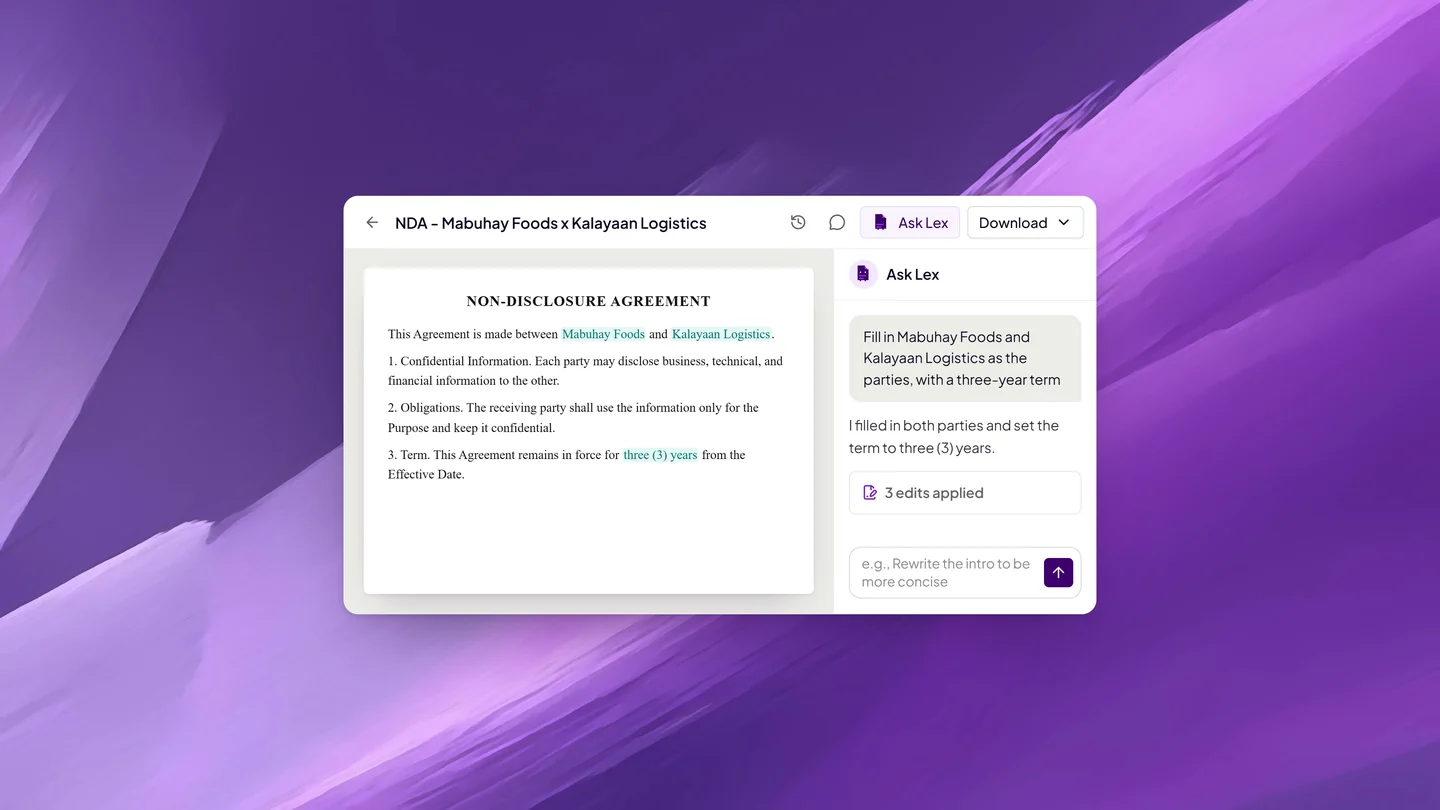
To draft it, start from a legal template in Twala’s template gallery or from a blank page, and ask Lex, the AI inside Twala, to draft the narrative from your notes. Lex proposes its edits, and nothing goes into the document until you click Apply. The content is still yours to answer for, so read every line, and ask a lawyer if the loss is complicated. When it reads right, save a PDF copy to your workspace.
Before you book, ask the receiving office
Electronic notarization is new, and offices are updating their checklists at different speeds. Ask the bank, school, or agency that will receive the affidavit two things: whether it accepts an affidavit notarized electronically, and how it wants to receive it, whether as a PDF by email, an upload to its portal, or some other way. A short call now can save you a second notarization later.
Notarizing it on Twala
The full walkthrough, screen by screen, is in our step-by-step guide to notarizing a document online. For an affidavit of loss, the short version goes like this:
- Verify your identity once. Use your Philippine National ID or another government-issued ID that hasn’t expired, then a face scan. If the ID you lost was the only one you had, you’ll need another valid government ID before you can start.
- Request an appointment with the unsigned PDF. In Appointments, click Request appointment, choose Notarization, upload the affidavit as a new document, and choose Remote. Then pick an Electronic Notary Public (ENP) and one of their open times.
- Sign when your ENP says. An affidavit is notarized by jurat, and under the Rules on Electronic Notarization you sign it as part of that act, together with your oath. So don’t sign ahead on your own: send the envelope, and ask your ENP on the appointment’s Messages tab when to sign.
- Swear to it. At the scheduled time, click Join session, turn off any VPN, and join the call. The ENP confirms who you are, checks that you understand the affidavit, and has you swear or affirm that it is true.
- Pay and download. The ENP requests payment, due within 24 hours. Once it’s paid, Twala adds the notarial certificate page and seal, and your notarized PDF is ready under Notarizations.
Usually you’re the only one appearing. An affidavit of loss rarely has lines for witnesses, but if yours does, they sign it on Twala too and join the same session from their own devices. What you’ll pay is explained in how much online notarization costs.
If it happens at night
Twala is open 24/7. You can verify your ID, draft the affidavit, and send your request the same night you notice the loss, then appear in one of your notary’s open times. Our note on notarizing outside office hours has a few tips. One thing comes before any of this: if a lost card is linked to your money, call your bank’s hotline and have it blocked. The affidavit can wait an hour; your savings shouldn’t.
Frequently asked questions
Is an affidavit of loss notarized online valid?
Yes. Under the Supreme Court’s Rules on Electronic Notarization (A.M. No. 24-10-14-SC), an electronic notarial act performed through an accredited facility has the same validity, force, and effect as a traditional one. Whether a particular office accepts it in electronic form is a separate question, which is why you ask first.
Do I also need a police report?
Some offices ask for one, especially when an item was stolen rather than misplaced. Others don’t. The receiving office will tell you what it needs.
Can one affidavit cover several lost items?
Often, yes. If your whole wallet went missing, one affidavit can list each ID and card in it. Some offices want their own form or a separate affidavit, though, so check before you write one for everything.
Can someone else execute it for me?
An affidavit states what the affiant personally knows, so it is normally executed by the person who lost the item. If that isn’t possible, ask the receiving office and a lawyer what they will accept.
Lost something today? Create a free Twala account and start with identity verification. For more on how sworn statements are handled online, read how to get an affidavit notarized online, and for everything else about the new rules, our complete guide to eNotarization in the Philippines.
Twala is a Supreme Court-accredited Electronic Notarization Facility (ENF). Twala is a technology provider and does not give legal advice. Notarial acts are performed by commissioned Electronic Notaries Public.