Why Twala: eNotarization and Document AI for Everyone

Twala is a Supreme Court-accredited eNotarization platform with more than 1.3 million individual users and more than 600 companies. Here is what it does for each kind of user, from a first-time signer to a bank.
It is tempting to sort eNotarization platforms by audience: one for individuals, another for companies, a third for lawyers. Documents don’t sort that way. A single loan agreement can be drafted by a cooperative’s staff in Davao, signed by a borrower in Bukidnon, notarized by a lawyer in Cagayan de Oro, and pulled up years later by an auditor in Manila. Twala was built so that all of those people work on the same platform, on the same record.
That design goes back to the company’s founding in 2020. As co-founder and General Counsel Atty. Third Bagro told a Land Registration Authority forum, Twala started from the premise that digitalization fails when it stops short of the end product of most transactions: the signed and notarized document. Six years later, Twala is one of the first three Electronic Notarization Facilities (ENFs) accredited by the Supreme Court, and the Philippines’ first two eNotarized documents were notarized on it at the official launch on October 19, 2026.
For individuals
Most people need a notary once or twice a year: an affidavit of loss for a lost ATM card, a special power of attorney so a sibling can deal with the bank, a lease for a new apartment. Twala makes that a few steps on a phone.
- Free to start. The account is free, signing documents is always free, and the Personal plan sends and stores 5 documents a month.
- One identity check. Verify once with your Philippine National ID, checked against the national registry, or another government-issued ID, plus a face scan. It stays valid until the ID expires or for three years.
- No office run. Appear over live video from anywhere in the Philippines, or choose an in-person session if you prefer.
- Open 24/7. Verify, sign, request a notarization, pay, and download at any hour, and book your session in one of the notary’s open times.
- A clear bill. Requesting is free. You pay the notarial fee the Electronic Notary Public (ENP) sets, with 12% VAT and documentary stamp tax, and a one-time identity verification fee.
Filipinos who can’t afford a lawyer have another door. Under the IBP and Twala legal aid program, participating lawyers give free online consultations to eligible beneficiaries, and Twala provides free eNotarization credits for eligible indigent clients. Read about it in free online legal help and eNotarization, or start with how to notarize a document online.
For lawyers and Electronic Notaries Public
For a lawyer with an electronic notarial commission, the platform decides who can find you and how much of your day goes to paperwork. A few things set Twala apart.
Your clients may already be on it. Everyone who appears in a notarization needs an account and a verified identity on the notary’s platform, and Twala already has more than 1.3 million individual users. Applying is free on any plan, and notarizing needs no subscription, only notary credits, which cost from about ₱65 to ₱100 each plus VAT depending on the package and never expire. A credit is spent only when you request payment for an act, so denying an act costs nothing.
The register keeps itself. Every act goes into your notarial register and is filed with the Supreme Court as soon as it is sealed, and each month becomes a notarial book. Fees are collected by payment link, and payouts arrive in your bank account or e-wallet on the schedule you choose (weekly, every two weeks, or monthly), less withholding tax and payment gateway fees. Between sessions, Lex can search Philippine laws and jurisprudence for you, and the Professional plan at ₱990 a month adds a document management system and AI tools for solo practice.
Twala signed a national partnership with the Integrated Bar of the Philippines in January 2026, with training and discounted packages for IBP members, and Twala Academy’s free course meets the Supreme Court’s training requirement for ENP applicants, with a certificate to attach to your application. Start with how to become an Electronic Notary Public and why ENPs choose Twala.
For businesses
Companies notarize more than people realize: secretary’s certificates, board resolutions, contracts with suppliers, employment documents, and SPAs for staff who deal with government offices. On paper, each one means printing, a messenger, and a wait.
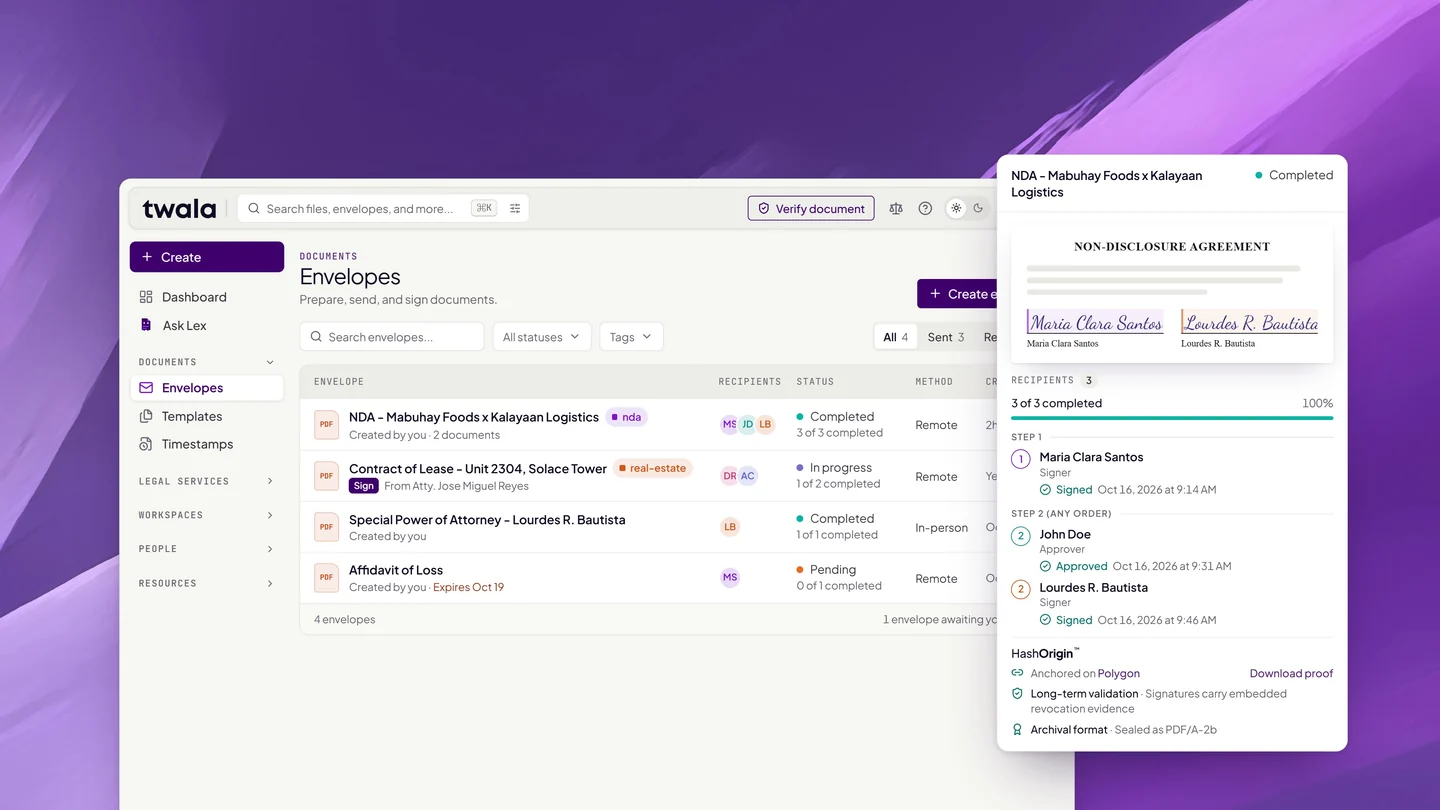
On Twala, a team works in shared workspaces with Owner, Admin, and Member roles, and owners and admins decide which members may use notary and AI features. Contracts start from templates, go out in envelopes with a signing order and reminders, and come back signed and ready to notarize without leaving the platform. Reports show where every envelope stands, and data extraction pulls dates and amounts out of finished agreements.
The Business plan, at ₱1,690 per seat a month with a minimum of three seats, adds team management, custom branding, and a Business verified digital seal. By Twala’s figures, customers see 80% faster turnaround and save 40% in time and materials per agreement. See eNotarization for businesses and from draft to notarized.
For enterprises and regulated industries
Banks, lending companies, cooperatives, insurers, and developers answer to auditors and regulators, so they ask harder questions. Twala’s identity checks are aligned with the Bangko Sentral ng Pilipinas’ e-KYC and authentication guidelines and with NIST SP 800-63-3, and the platform follows Cloud Signature Consortium standards for cloud-based digital signatures.
The Enterprise plan adds single sign-on through SAML or OpenID Connect, SIEM integration, advanced logging, a PKI digital seal, a guaranteed SLA, and premium support. Underneath, the audit log carries HMAC-SHA256 integrity checks, the database keeps a standby in sync, and formal Disaster Recovery and Business Continuity Plans are in place. Lex runs privately, and no user data is ever used to train the AI. Twala is also working toward certification under ISO/IEC 27001, with an internal information security management system already running.
In 2023, NATCCO signed a two-year contract with Twala to digitalize the cooperative sector. The details of the security model are in inside Twala’s security and eNotarization for banks, lending companies, and cooperatives.
For government
Twala has worked with the public sector from the start. Its work with the Supreme Court on electronic notarization began in July 2020. It received a ₱4.6 million startup grant from DOST-PCIEERD in 2022 and keeps an R&D partnership with DOST-ASTI. In 2024, the Anti-Red Tape Authority named it an Ease of Doing Business Champion, the only non-government awardee among 21.
The first two eNotarized documents in the country were signed and notarized on Twala, witnessed by First Lady Louise Araneta-Marcos, Senior Associate Justice Marvic M.V.F. Leonen, DICT Secretary Robert Joseph de Claro, and ARTA Director General Secretary Ernesto V. Perez. More reach is coming. “I am also excited to announce that Twala will soon integrate with the eGov app, making eNotarization easier to access through a platform already being used by millions of Filipinos,” said Engr. Jeffrey Reyes, Twala’s Co-founder and CEO, at the launch.
The rest of government is moving as well. On October 13, 2026, the Supreme Court signed joint memorandum circulars with the Land Registration Authority and the Securities and Exchange Commission on the use of electronically notarized documents in their transactions. Associate Justice Alfredo Benjamin Caguioa said at the signing that the circulars “categorically clarify the acceptability of eNotarized documents.”
For agencies, the practical question is how to accept and check eNotarized documents without asking for paper. We answer it in how government offices can accept and verify eNotarized documents.
One platform, one record
What connects all of these users is the record. On Twala, AI drafting, review, eSignature, eNotarization, and storage are parts of one platform, so a document can be drafted, signed, notarized, stored, and tracked without being downloaded and uploaded somewhere else along the way. The platform is open 24/7, so the work doesn’t stop when an office closes. Every sealed document carries a digital signature and a fingerprint anchored on the Polygon blockchain with HashOrigin™ technology, so anyone holding a copy can confirm it is genuine.
“We built Twala so a document never has to leave the platform to be trusted. It’s drafted, signed, notarized, and sealed in one place,” says Alexander Paul Quinit, Twala’s Co-founder and CTO.
Wherever you fit, the first step is the same: create a free Twala account. Read Get notarized if you need a document notarized, apply as an ENP if you are a lawyer, or talk to our team about your company. For the rules behind it all, see our complete guide to eNotarization in the Philippines.
Twala is a Supreme Court-accredited Electronic Notarization Facility (ENF). Twala is a technology provider and does not give legal advice. Notarial acts are performed by commissioned Electronic Notaries Public.